Русский
 Türkçe
 中文
中文
Red + Near-Infrared LED Therapy for Skin Rejuvenation
Red and near-infrared LED therapy is one of the most established multi-wavelength combinations used in professional aesthetic skin rejuvenation.
The two wavelength ranges are closely related, but they are not identical.
Visible red LED light commonly includes wavelengths such as:
633nm
660nm
while near-infrared LED commonly includes wavelengths such as:
830nm
850nm
In professional aesthetic programs, red light is primarily positioned around:
- skin rejuvenation
- visible skin texture
- radiance
- mature-looking skin
- overall complexion care
Near-infrared light can complement red LED by extending the wavelength range used within the treatment program.
This makes red + NIR particularly relevant for:
- mature-looking skin
- early visible signs of aging
- dull-looking complexion
- tired-looking skin
- skin-conditioning programs
- post-aesthetic care
- advanced multi-wavelength facial rejuvenation
Clinical studies have specifically evaluated combinations such as 633nm red + 830nm near-infrared LED for facial rejuvenation and photoaged skin.
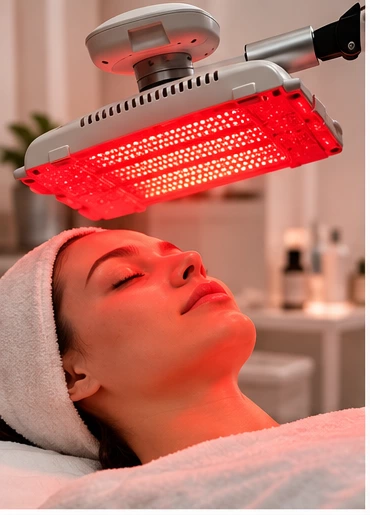
[Image 1: Red + Near-Infrared LED Therapy for Skin Rejuvenation]
Why Combine Red and Near-Infrared LED Light?
Using two wavelength ranges should have a clear purpose.
The advantage of red + near-infrared therapy is not simply:
more wavelengths = better treatment.
Instead, each wavelength range contributes differently to the overall program.
Red LED Light
Typical wavelengths:
633nm / 660nm
Primary aesthetic positioning:
- visible skin rejuvenation
- skin texture
- radiance
- mature-looking skin
- facial conditioning
Near-Infrared LED Light
Typical wavelengths:
830nm / 850nm
Primary aesthetic positioning:
- longer-wavelength skin conditioning
- skin revitalization
- mature-looking skin
- post-aesthetic care
- complementary multi-wavelength treatment
Together, red and near-infrared LED can create a broader rejuvenation program than either wavelength range alone.
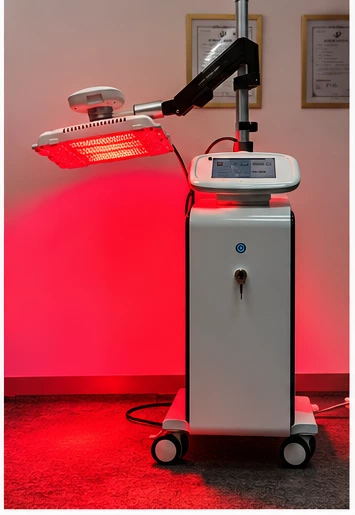
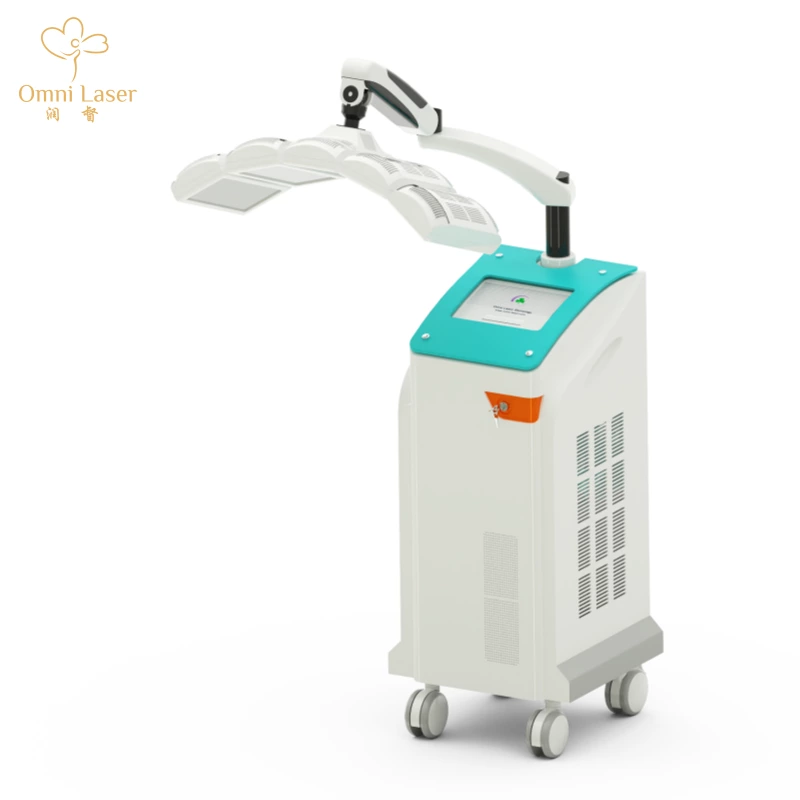
[Image 2: Professional Red + Near-Infrared LED Therapy Device]
The Role of Red LED Light in Skin Rejuvenation
Visible red LED light has one of the strongest evidence bases among cosmetic LED wavelengths.
Wavelengths such as:
633nm
and:
660nm
have been investigated for facial rejuvenation, wrinkles and photoaged skin.
A randomized split-face study using 633nm red LED, 830nm near-infrared LED and their combination reported improvements in wrinkle measurements and skin elasticity compared with baseline.
Other research has also investigated 660nm LED for visible signs of facial aging and skin texture.
For professional aesthetic marketing, red LED can therefore be positioned around:
- fine-line care
- skin texture
- skin radiance
- mature-looking skin
- skin rejuvenation
- overall skin conditioning
Red LED should remain the primary visible rejuvenation wavelength within the combination.
The Role of Near-Infrared LED Light
Near-infrared light lies beyond visible red light.
Common professional NIR wavelengths include:
830nm
and:
850nm
Unlike red LED, near-infrared light is largely invisible to the human eye.
Its longer wavelength means that it behaves differently within biological tissue compared with visible red light.
In professional aesthetic programs, near-infrared LED can be positioned around:
- skin revitalization
- mature-looking skin
- complementary deeper skin conditioning
- post-aesthetic care
- broader rejuvenation programs
The most important point is:
Near-infrared light should complement red light rather than simply duplicate it.
This is what makes the combination useful.
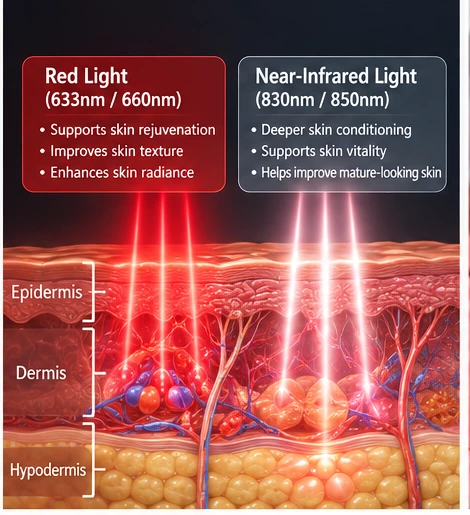
[Image 3: Red and Near-Infrared LED Light Interaction with the Skin]
Key Aesthetic Applications of Red + Near-Infrared LED Therapy
Mature-Looking Skin
One of the primary applications of red + NIR therapy is mature-looking skin.
Clients may be concerned with:
- fine lines
- dull complexion
- uneven-looking texture
- reduced radiance
- tired-looking skin
- loss of visible vitality
A multi-wavelength red + NIR program can provide a gentle, non-invasive approach to professional skin rejuvenation.
Fine-Line and Texture Care
Fine lines and rough-looking texture are common reasons clients seek professional rejuvenation treatments.
Clinical studies using red and near-infrared LED combinations have reported improvements in wrinkles and skin-surface measurements after repeated treatments.
For marketing purposes, the preferred wording is:
supports smoother-looking skin
helps improve the appearance of fine lines
rather than:
removes wrinkles
or:
reverses aging
Dull and Tired-Looking Skin
Red + near-infrared LED therapy can also be incorporated into facial programs for clients whose skin appears:
- dull
- tired
- less radiant
- uneven in overall appearance
This makes it suitable not only for older clients but also for broader rejuvenation programs.
Skin Revitalization
Professional rejuvenation does not always require aggressive energy-based treatment.
For some clients, the goal is simply:
- fresher-looking skin
- improved skin vitality
- smoother appearance
- more radiant complexion
Red + NIR LED can be incorporated into these gentle maintenance-oriented programs.
Post-Aesthetic Skin Conditioning
Red and near-infrared wavelengths can also be used within post-aesthetic care programs.
After selected procedures, skin may temporarily appear:
- red
- dry
- sensitive
- stressed-looking
LED therapy may be incorporated when appropriate for:
- the procedure
- client condition
- device instructions
- professional assessment
The correct positioning is:
post-aesthetic skin conditioning
rather than:
healing injury
or:
treating inflammation
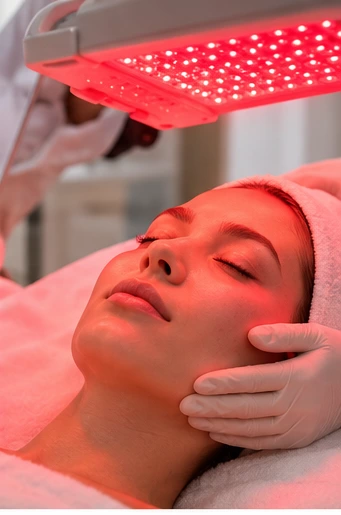
[Image 4: Red + Near-Infrared LED Facial Skin Rejuvenation]
633nm Red + 830nm Near-Infrared LED
One of the best-documented red + NIR combinations is:
633nm + 830nm
This pairing appears in several clinical studies on facial photoaging and skin rejuvenation.
A prospective randomized split-face study treated participants with:
- 633nm alone
- 830nm alone
- 633nm + 830nm
- sham light
and reported improvements in wrinkles and elasticity in the active treatment groups.
Other clinical studies using the same general wavelength combination also reported improvements in visible photoaging and skin texture.
For professional aesthetic positioning:
633nm Red
→ visible rejuvenation
830nm Near-Infrared
→ complementary longer-wavelength skin conditioning
This combination is therefore highly relevant for advanced professional LED rejuvenation programs.
660nm Red + 850nm Near-Infrared LED
Another common commercial combination is:
660nm + 850nm
660nm red light is widely used in photobiomodulation and skin rejuvenation research.
850nm near-infrared is also commonly incorporated into professional and home-use multi-wavelength LED systems.
A prospective study has evaluated a combined 660nm + 850nm LED mask in photoaged skin-care applications.
For professional aesthetic use, this combination can be positioned around:
- mature-looking skin
- skin vitality
- facial rejuvenation
- skin-conditioning programs
- maintenance-oriented aesthetic care
However, as always, treatment performance depends on more than wavelength alone.
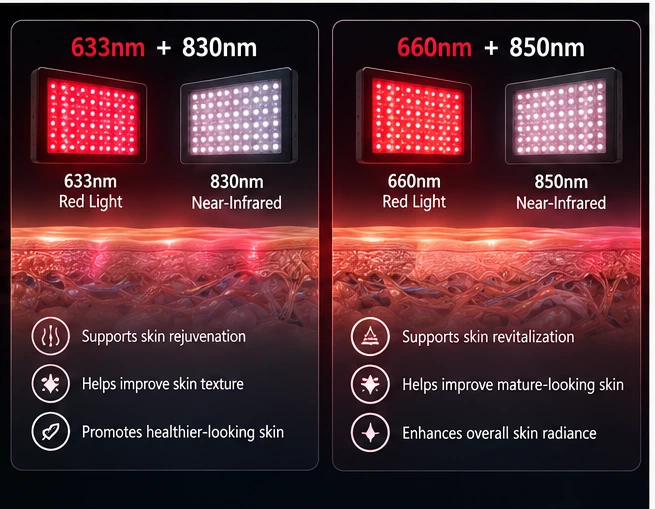
[Image 5: 633nm + 830nm and 660nm + 850nm LED Combinations]
Is 633nm + 830nm Better Than 660nm + 850nm?
Not necessarily.
Both combinations are relevant.
The more important question is whether the overall system is well designed.
Professional LED performance depends on:
- wavelength
- irradiance
- energy density
- treatment distance
- exposure time
- optical uniformity
- treatment area
- protocol design
Therefore:
633nm + 830nm
should not automatically be described as superior to:
660nm + 850nm
or vice versa.
The appropriate configuration depends on:
- device design
- intended application
- treatment protocol
- professional positioning
Red + Near-Infrared LED vs Red LED Alone
Red LED alone can be highly relevant for skin rejuvenation.
So why add near-infrared light?
The distinction is:
Red LED Alone
More focused on:
- visible skin rejuvenation
- radiance
- texture
- mature-looking skin
Red + Near-Infrared LED
Broader positioning around:
- rejuvenation
- skin revitalization
- mature-looking skin
- post-aesthetic conditioning
- advanced multi-wavelength facial care
This does not mean that combination treatment is always better.
It means that the clinic has a broader wavelength program available when the treatment objective requires it.
Who Is Red + Near-Infrared LED Therapy Suitable For?
Within professional aesthetic skin care, red + NIR therapy may be considered for clients concerned with:
- mature-looking skin
- early visible signs of aging
- fine lines
- uneven-looking texture
- dull complexion
- tired-looking skin
- reduced radiance
- post-aesthetic skin conditioning
- overall facial rejuvenation
- maintenance-oriented skin care
Treatment selection should always take into account:
- individual skin condition
- professional assessment
- treatment goals
- previous aesthetic procedures
- device configuration
- treatment parameters
How Is Red + Near-Infrared LED Therapy Used in Professional Aesthetic Clinics?
Standalone Rejuvenation Program
Red + NIR can be used as a gentle, non-invasive facial rejuvenation program.
Anti-Aging Facial Program
Professional clinics may incorporate red + NIR into broader anti-aging protocols focused on:
- skin texture
- fine-line appearance
- radiance
- mature-looking skin
Post-Aesthetic Care
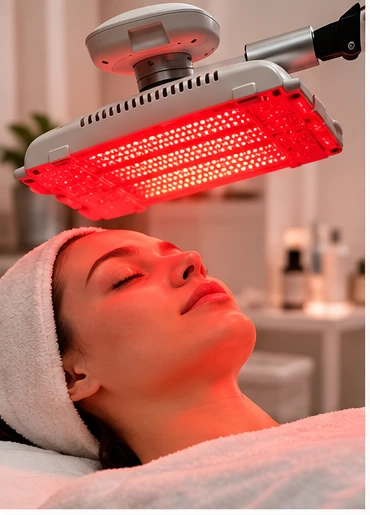
Red + NIR LED may be incorporated after selected aesthetic procedures when appropriate.
The goal should remain:
skin conditioning
rather than treatment of procedure complications.
Maintenance Program
Because LED phototherapy is non-ablative, red + NIR can be incorporated into repeat professional skin-care programs.
Multi-Wavelength Program
Red + near-infrared LED can also serve as the foundation for broader multi-wavelength treatment programs.
For example:
Red + Yellow + Near-Infrared
can be used when the clinic wants to combine:
- rejuvenation
- sensitive-skin care
- post-aesthetic conditioning
[Image 6: Professional Red + Near-Infrared LED Treatment in Aesthetic Clinics]
Red + Near-Infrared LED vs Red + Blue LED
These two combinations should have clearly different positioning.
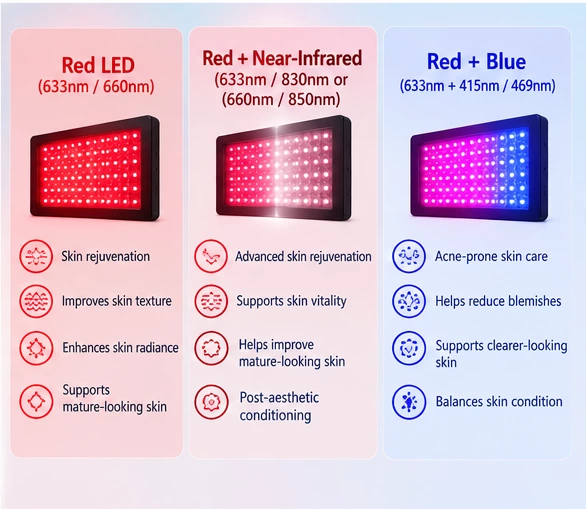
Red + Near-Infrared LED
Primary focus:
- skin rejuvenation
- mature-looking skin
- fine-line care
- skin vitality
- post-aesthetic conditioning
Red + Blue LED
Primary focus:
- acne-prone skin
- blemish-prone skin
- oily skin
- clearer-looking skin
- skin conditioning
This distinction is important for both:
client understanding
and:
SEO structure
because the two pages target different search intent.
Red + Near-Infrared LED vs Yellow + Red LED
These combinations also serve different aesthetic needs.
Red + Near-Infrared LED
Focus:
advanced rejuvenation
mature-looking skin
skin vitality
Yellow + Red LED
Focus:
sensitive-looking skin
redness-prone skin
gentle conditioning
rejuvenation support
This makes it easier for clinics to select programs according to the client's primary concern.
[Image 7: Red + Near-Infrared LED vs Red + Blue vs Yellow + Red LED Programs]
What Determines the Performance of a Professional Red + Near-Infrared LED System?
Wavelength Configuration
Professional buyers should know the actual wavelengths used.
Typical examples include:
633nm / 660nm Red
and:
830nm / 850nm Near-Infrared
Irradiance
Irradiance represents optical power delivered over the treatment area.
It is commonly expressed in:
mW/cm²
Energy Density
Energy density represents total optical energy delivered during treatment.
It is commonly expressed in:
J/cm²
Treatment Distance
The distance between the LED panels and skin affects actual delivered irradiance.
Optical Uniformity
Professional facial treatment requires relatively even light distribution across the treatment area.
Panel Geometry
Panel geometry affects how evenly the face is surrounded by light.
Omni Laser professional LED systems are available in:
3-Panel
and:
5-Panel
configurations.
These designs allow clinics and distributors to select different treatment-head structures according to product requirements and coverage preferences.
No single panel configuration should be judged solely by size or appearance.
Overall performance depends on the complete optical system.
Treatment Sequence
Depending on system design, red and near-infrared wavelengths may be delivered:
- simultaneously
- sequentially
- according to preset protocols
The appropriate method depends on device design.
Treatment Protocol
Professional LED therapy should be evaluated as:
wavelength + irradiance + energy density + distance + time + coverage + protocol
rather than wavelength alone.
Professional Red + Near-Infrared LED Therapy Systems from Omni Laser
Omni Laser develops professional multi-wavelength LED phototherapy systems for:
- aesthetic clinics
- professional skin-care centers
- medical-aesthetic practices
- distributors
- beauty equipment brands
- OEM/ODM partners
Depending on system configuration, Omni Laser LED platforms can incorporate:
Red Light
including wavelengths such as:
633nm / 660nm
and:
Near-Infrared Light
including wavelengths such as:
830nm / 850nm
Omni Laser professional LED systems are available in:
3-Panel
and:
5-Panel
treatment-head configurations.
These designs allow professional buyers to select different coverage structures according to:
- treatment-area requirements
- product positioning
- clinic environment
- OEM/ODM requirements
When evaluating a professional red + near-infrared system, buyers should consider:
- actual wavelength configuration
- irradiance
- energy density
- optical uniformity
- treatment distance
- panel geometry
- treatment-area coverage
- software protocols
- system stability
- manufacturer support
- regulatory documentation
rather than judging the system by wavelength count alone.
Frequently Asked Questions About Red + Near-Infrared LED Therapy
What is red and near-infrared LED therapy used for?
In professional aesthetic skin care, red + near-infrared LED therapy can be incorporated into programs for:
- skin rejuvenation
- mature-looking skin
- fine-line care
- skin vitality
- post-aesthetic skin conditioning
What red wavelengths are commonly used?
Common professional red wavelengths include:
633nm
and:
660nm
What near-infrared wavelengths are commonly used?
Common NIR wavelengths include:
830nm
and:
850nm
Is near-infrared light visible?
No, or only minimally.
Near-infrared wavelengths are largely outside the visible range.
Why combine red and near-infrared light?
Red and NIR wavelengths have different optical characteristics and can complement each other within a broader rejuvenation program.
Is 633nm + 830nm well studied?
Yes.
633nm + 830nm is one of the most frequently published LED combinations in facial rejuvenation research.
Can 660nm and 850nm be used together?
Yes.
660nm + 850nm is also a common red/NIR combination in commercial LED systems and has been investigated in aesthetic applications.
Is red + near-infrared better than red alone?
Not necessarily.
Red alone may be appropriate for focused rejuvenation programs.
Red + NIR provides a broader multi-wavelength option when the clinic wants additional skin-conditioning flexibility.
Is red + near-infrared suitable for post-aesthetic care?
It can be incorporated into professional post-aesthetic skin-conditioning programs when appropriate for:
- the procedure
- client
- device instructions
- professional assessment
What is the difference between a 3-panel and 5-panel system?
The main difference is treatment-head geometry and coverage design.
Both configurations can be used for professional aesthetic LED programs.
The appropriate choice depends on:
- treatment-area requirements
- clinic workflow
- product positioning
- device design
How should clinics choose a professional red + NIR LED system?
Professional buyers should evaluate:
- wavelengths
- irradiance
- energy density
- treatment distance
- optical uniformity
- panel geometry
- treatment area
- protocols
- system stability
- manufacturer support
rather than focusing on wavelength alone.
Professional Red + Near-Infrared LED Solutions for Skin Rejuvenation
Red + near-infrared LED therapy is one of the most established multi-wavelength approaches in professional aesthetic skin care.
Its treatment logic is clear:
Red LED
→ skin rejuvenation
→ texture
→ radiance
→ mature-looking skin
Near-Infrared LED
→ complementary longer-wavelength skin conditioning
→ skin revitalization
→ post-aesthetic support
Together, they can form a comprehensive professional rejuvenation program.
For Omni Laser, red + NIR should therefore be positioned as:
Advanced Multi-Wavelength Skin Rejuvenation
rather than simply:
“two colors combined.”
Omni Laser professional LED systems are available in 3-panel and 5-panel configurations, allowing different product designs to support different professional clinic and distributor requirements.
Explore Omni Laser Professional LED Therapy Systems →
Learn More About Red LED Light Therapy for Skin Rejuvenation →
Learn More About Near-Infrared LED Therapy for Skin Revitalization →
Contact Omni Laser for Professional LED Therapy OEM/ODM Solutions →