Русский
 Türkçe
 中文
Professional LED Phototherapy System Series
Explore Omni Laser professional LED phototherapy systems with 3-panel and 5-panel treatment heads, customizable wavelengths, evenly distributed LED layouts, engineered thermal management and multiple system designs for clinics and OEM/ODM projects.
- Item NO.:
- OL-PDT300/600/950
- Payment
- EXW, FOB,CIF, DAP,DDP
- Product Origin
- Shanghai,CHINA
- Device Color
- White/Black/Customized
- Delivery Method
- Air Express/Sea Ship/Land Carriage
- Lead Time
- 7-15 workdays
- Treatment Color
- Red/Blue/Infared/Yellow/Green/Others


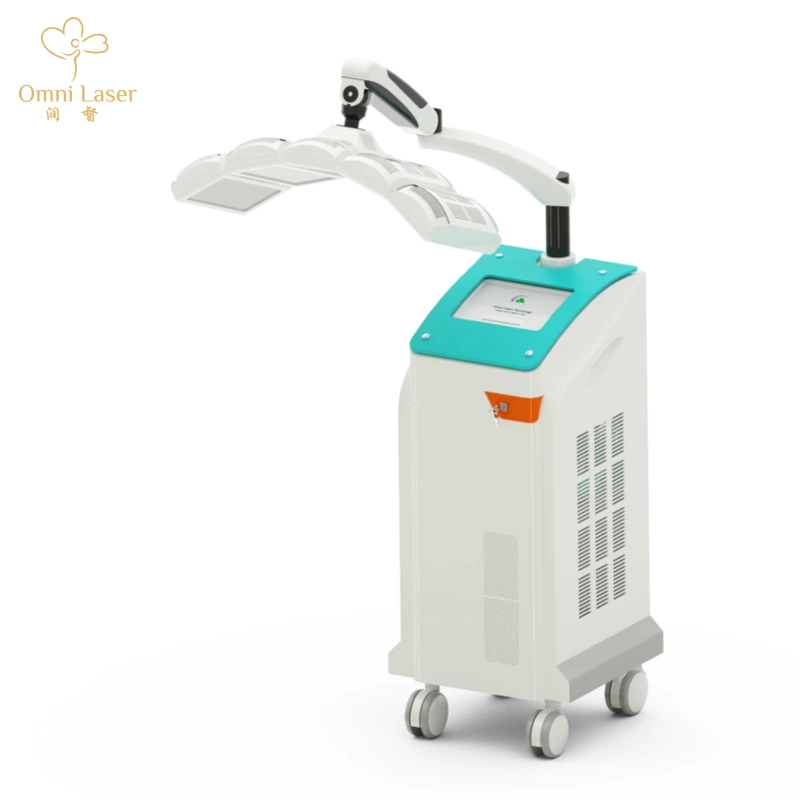


Professional LED Phototherapy System Series
Multiple System Designs. Two Treatment-Head Geometries. Configurable Professional Wavelengths.
Omni Laser offers a complete series of professional LED phototherapy systems for aesthetic clinics, distributors, private-label brands and OEM/ODM projects.
Different models are available with different main-unit designs, housing styles and product positioning.
However, the core treatment platform is built around two professional LED treatment-head configurations:
3-Panel LED Treatment Head
and
5-Panel LED Treatment Head
Depending on the selected system and project requirements, professional wavelength options can include:
405–420nm Blue
469nm Blue
530nm Green
590nm Yellow
633nm Red
660nm Red
830nm Near-Infrared
and
850nm Near-Infrared
Rather than maximizing the number of colors in one treatment head, Omni Laser focuses on selecting appropriate wavelengths while maintaining useful LED density, optical output and treatment-field distribution.
[IMAGE 1 — Hero Image: Omni Laser Professional LED Phototherapy System Series]
Suggested image content:
Several real Omni Laser LED system styles arranged together, including both 3-panel and 5-panel treatment heads.
Use real product images.
No artificial four-panel or six-panel treatment heads.
One Optical Platform, Multiple System Designs
Professional customers often need different machine appearances for different markets.
A distributor may prefer a compact unit.
A premium aesthetic clinic may prefer a larger floor-standing design.
An OEM customer may want a customized housing, user interface or brand appearance.
For this reason, Omni Laser provides multiple main-unit styles while maintaining the same overall LED engineering principles.
Across the series, product models may differ in:
-
main-unit appearance
-
housing dimensions
-
screen design
-
control interface
-
treatment-head support structure
-
clinic positioning
-
OEM/ODM options
The core LED treatment architecture can still be selected according to:
-
3-panel or 5-panel geometry
-
wavelength configuration
-
treatment objective
-
optical-output requirement
This allows professional customers to select the system style and optical configuration separately.
Choose Your Treatment-Head Configuration
The first major choice is not the machine housing.
It is the treatment-head geometry.
Omni Laser professional LED systems are based on:
3-Panel
or:
5-Panel
treatment-head configurations.
3-Panel LED Treatment Head
The 3-panel structure provides a compact and flexible optical geometry.
Its central panel and adjustable side panels allow the treatment head to surround the facial treatment area from multiple angles.
Main Characteristics
-
compact treatment geometry
-
adjustable side panels
-
suitable for facial treatment areas
-
flexible positioning
-
professional multi-wavelength configuration
-
suitable for clinics preferring a smaller treatment-head structure
The 3-panel design is particularly suitable when treatment flexibility and compact system dimensions are important.
[IMAGE 2 — Real 3-Panel LED Treatment Head]
Suggested image content:
Use a real Omni Laser 3-panel system.
Prefer a real multi-wavelength operating image such as Red + Blue + NIR.
Do not alter the real panel number.
5-Panel LED Treatment Head
The 5-panel structure provides broader surrounding optical coverage.
Additional adjustable panels can increase lateral illumination and treatment-field width.
Main Characteristics
-
broader surrounding treatment geometry
-
wider treatment area
-
increased lateral coverage
-
flexible panel positioning
-
suitable for full-face and larger-area applications
-
professional multi-wavelength configuration
The purpose of the additional panels is not simply to make the device larger.
The main difference is:
Optical Geometry
and
Treatment Coverage
[IMAGE 3 — Real 5-Panel LED Treatment Head]
Suggested image content:
Use the real Omni Laser 5-panel system.
A Red + Yellow + NIR operating image is ideal.
NIR should not appear as a bright third visible color.
3-Panel or 5-Panel: Which Should You Choose?
Neither structure should automatically be described as better.
The appropriate choice depends on:
-
treatment area
-
clinic workflow
-
product positioning
-
treatment-head size preference
-
surrounding coverage requirements
-
main-unit design
3-Panel
Best suited when the project requires:
Compact Geometry + Flexible Facial Positioning
5-Panel
Best suited when the project requires:
Broader Coverage + More Surrounding Illumination
Panel quantity alone does not determine performance.
Wavelength selection, irradiance, wavelength distribution and panel positioning remain equally important.
Choose Your System Style
Once the treatment-head structure has been selected, customers can choose from different Omni Laser main-unit designs.
The LED platform is available in multiple system styles for different clinic and market requirements.
Current and upcoming styles can include:
OL-PDT100
Professional LED phototherapy system with a compact main-unit design.
OL-PDT300
Alternative professional housing style for aesthetic clinics and distributors.
OL-PDT600
Professional floor-standing LED phototherapy system with a different main-unit design.
OL-PDT950
Professional LED phototherapy platform used across current Omni Laser optical testing and engineering data.
New System Design A
Coming Soon
New-generation main-unit design based on the same professional LED platform.
New System Design B
Coming Soon
Additional new system appearance for different distributor and private-label positioning.
[IMAGE 4 — Omni Laser LED System Style Selection]
Suggested image content:
A clean comparison of:
OL-PDT100
OL-PDT300
OL-PDT600
OL-PDT950
New Model A
New Model B
Use real product photos for existing systems.
Reserve image placeholders for the two new models until their design is finalized.
Different Appearance, Shared LED Engineering Principles
Different Omni Laser system styles should not be interpreted as completely different LED technologies.
Depending on the selected configuration, the systems can share the same professional engineering concepts:
-
defined LED wavelength selection
-
3-panel or 5-panel treatment geometry
-
multi-wavelength LED distribution
-
measured irradiance
-
professional thermal management
-
customizable treatment programs
This makes it possible for distributors and OEM/ODM customers to select a machine style that suits their market without redesigning the complete optical concept from the beginning.
Configurable Professional LED Wavelengths
Omni Laser LED platforms can be configured with different wavelengths according to the intended professional application.
| Spectral Region | Available Wavelengths | Typical Professional Positioning |
|---|---|---|
| Blue | 405–420nm / 469nm | Acne-oriented projects, oily-looking and blemish-prone skin care |
| Green | 530nm | Complexion and skin-tone conditioning |
| Yellow | 590nm | Sensitive-looking and redness-prone skin care |
| Red | 633nm / 660nm | Skin rejuvenation and mature-looking skin care |
| Near-Infrared | 830nm / 850nm | Longer-wavelength skin conditioning and multi-wavelength programs |
The exact wavelength matters.
For example:
405–420nm Blue
and
469nm Blue
belong to the same broad color category but should not automatically be treated as identical.
Likewise:
633nm and 660nm Red
or
830nm and 850nm NIR
should be selected according to the intended application and protocol.
Why Omni Laser Usually Recommends Three Wavelengths
A professional LED treatment head has a fixed physical area.
Within this area, the available space must accommodate:
-
LED emitters
-
PCB circuitry
-
electrical connections
-
optical spacing
-
thermal-management structures
If more wavelength groups are continuously added into the same fixed panel area, the available LED positions must be divided among more channels.
For example:
Three-Wavelength Treatment Head
The available LED positions are distributed among:
Red + Yellow + NIR
or
Red + Blue + NIR
Five-Wavelength Treatment Head
The same physical area must be divided among:
Blue + Green + Yellow + Red + NIR
All other factors being equal, adding more wavelength groups can reduce:
-
LED quantity allocated to each wavelength
-
per-wavelength emitter density
-
available per-channel optical output
-
spatial density of each wavelength
For this reason, Omni Laser generally recommends:
Approximately Three Carefully Selected Wavelength Groups per Treatment Head
The objective is not to maximize color quantity.
The objective is to maintain a practical balance between:
Wavelength Flexibility
LED Density
Per-Channel Irradiance
Spatial Uniformity
More Colors Do Not Automatically Mean Better Performance
LED equipment is sometimes marketed by the number of available colors:
5 colors.
7 colors.
9 colors.
But color quantity alone does not describe professional optical performance.
The important question is:
How much useful optical output does each selected wavelength actually provide across the treatment area?
For Omni Laser, a well-designed 3-wavelength configuration can be more meaningful than adding several additional wavelengths simply for marketing purposes.
Four- or five-wavelength configurations can still be evaluated for customized projects.
However, each additional wavelength should have:
-
a clear optical purpose
-
sufficient LED allocation
-
measurable output
-
appropriate thermal design
-
real protocol value
[IMAGE 5 — Three Wavelengths vs Too Many Wavelengths in a Fixed Panel Area]
Suggested image content:
Left:
3 Selected Wavelengths
showing strong LED density per wavelength.
Right:
More Wavelength Groups
showing the same physical panel divided among more channels.
Main message:
Fixed Treatment Area → More Wavelength Groups = Fewer Available LED Positions per Channel
Do not imply that four or five wavelengths are impossible.
Typical Three-Wavelength Configurations
Red + Blue + Near-Infrared
Possible wavelength options include:
633nm / 660nm Red
405–420nm / 469nm Blue
830nm / 850nm NIR
This creates three distinct optical regions within one treatment head.
Red + Yellow + Near-Infrared
Possible configuration:
633nm / 660nm Red
590nm Yellow
830nm / 850nm NIR
This combination can be configured for professional aesthetic projects focused on:
-
sensitive-looking skin
-
redness-prone skin
-
skin rejuvenation
-
mature-looking skin
-
multi-wavelength conditioning
Red + Blue + Green
Another professional configuration can combine:
Red
Blue
530nm Green
according to the product's intended aesthetic positioning.
The correct combination should always be based on:
Application
rather than:
Color Quantity
Evenly Interspersed Multi-Wavelength LED Distribution
Selecting the right wavelengths is only one part of the design.
Another important factor is:
where those LEDs are physically positioned.
Omni Laser multi-wavelength treatment heads use an evenly interspersed LED layout.
Instead of dividing the treatment panel into large isolated color zones, selected wavelength emitters are distributed repeatedly across the treatment area.
For example:
Red + Blue + NIR
The wavelength rows are arranged in a repeating distributed pattern.
Red + Yellow + NIR
Red, yellow and NIR emitter positions are also distributed throughout the panel.
This helps selected wavelengths cover the same treatment field more evenly.
[IMAGE 6 — Real Interspersed Multi-Wavelength LED Layout]
Suggested image content:
Use real Omni Laser PCB images.
Show:
Red + Blue + NIR
and
Red + Yellow + NIR
The three wavelength groups must be completely interspersed according to the real PCB layout.
Do not create large separated color blocks.
Near-Infrared May Be Invisible During Treatment
830nm and 850nm lie outside the normal visible range of the human eye.
Therefore, when:
Red + Blue + NIR
operate simultaneously,
the treatment head primarily appears:
Red + Blue
Likewise:
Red + Yellow + NIR
primarily appears:
Red + Yellow
The near-infrared channel can still be operating even though it is not visibly bright.
NIR output should therefore be evaluated using optical measurement rather than visual brightness.
Optical Performance and Dosimetry
Professional LED performance should be evaluated using measured optical parameters rather than electrical wattage or visible brightness alone.
For detailed information about:
-
irradiance
-
energy density
-
treatment distance
-
single-wavelength output
-
combined-wavelength output
-
optical uniformity
-
3-panel and 5-panel optical geometry
please refer to the dedicated technical article:
LED Dosimetry, Irradiance & Treatment Distance →
Professional Thermal Management
High-density LED arrays generate heat during continuous operation.
Omni Laser treatment heads use a combined thermal-management architecture based on:
PCB Heat Transfer
Aluminum Heat Sinks
Forced-Air Cooling Fans
The LED PCB transfers heat toward aluminum heat-sink structures installed behind the board.
Cooling fans then create airflow across the heat sinks, helping remove accumulated heat during continuous operation.
The cooling system is part of the engineering required to create more controlled operating conditions for the LED components and drive electronics.
[IMAGE 7 — Real Omni Laser LED Thermal Management Structure]
Suggested image content:
Use the real hardware photos:
LED PCB front
PCB rear with aluminum heat sinks
fan cover
thermal camera measurement
Do not use generic AI cooling components.
Continuous Temperature Testing
Omni Laser has evaluated temperature behavior during continuous operation on both:
3-Panel
and
5-Panel
treatment-head configurations.
Testing includes individual wavelength operation as well as higher-load multi-wavelength operation.
For detailed thermal data, cooling architecture and continuous-operation analysis:
Explore LED Thermal Management & Optical Stability →
Professional Aesthetic Applications
Different wavelengths and wavelength combinations can support different professional aesthetic programs.
Rather than repeating all treatment mechanisms on the product page, Omni Laser provides dedicated treatment resources for each application.
Acne-Prone and Oily-Looking Skin
Professional blue-light programs can be configured according to the selected blue wavelength and intended application.
Learn About Blue LED Therapy →
Skin Rejuvenation
Red LED wavelengths such as:
633nm
or
660nm
can be used in professional rejuvenation-oriented protocols.
Learn About Red LED Therapy →
Sensitive-Looking and Redness-Prone Skin
590nm Yellow
can be configured for gentle professional skin-conditioning programs.
Learn About 590nm Yellow LED Therapy →
Uneven-Looking Complexion
530nm Green
can be selected for complexion-oriented aesthetic programs.
Learn About Green LED Therapy →
Near-Infrared Skin Conditioning
830nm
or
850nm
can be incorporated into longer-wavelength professional LED programs.
Learn About Near-Infrared LED Therapy →
Multi-Wavelength Programs
Dedicated treatment resources are also available for:
Red + Blue
Red + Yellow
Red + NIR
and
Red + Yellow + NIR
professional applications.
[IMAGE 8 — Professional LED Treatment Applications]
Suggested image content:
Clean application navigation using real product imagery and skin-care concepts.
Avoid disease-treatment imagery.
Use:
Acne-Prone Skin Care
Skin Rejuvenation
Sensitive-Looking Skin
Complexion Conditioning
Multi-Wavelength Programs
LED Phototherapy, PDT and PBM
The Omni Laser system is positioned primarily as a:
Professional LED Phototherapy Platform
LED phototherapy refers to the light-delivery system itself.
Photosensitizer-Assisted PDT Projects
Photodynamic therapy generally combines:
Photosensitizer + Appropriate Light + Oxygen
Omni Laser does not supply photosensitizers as part of the standard LED phototherapy system.
However, professional customers who already have an established photosensitizer-assisted protocol may evaluate an Omni Laser LED platform according to:
-
photosensitizer absorption spectrum
-
required activation wavelength
-
irradiance
-
radiant exposure
-
treatment geometry
-
regulatory pathway
The important technical question is:
Does the LED platform provide the optical parameters required by the customer's protocol?
PBM and Wellness Projects
Red and near-infrared wavelengths also form the technical basis of many photobiomodulation applications.
However, PBM systems require their own consideration of:
-
wavelength
-
dose
-
target tissue
-
treatment geometry
-
intended use
Omni Laser can therefore develop PBM / Wellness products separately from the standard professional aesthetic LED platform.
For more technical information:
Explore LED Phototherapy Wavelength Technology →
OEM & ODM LED Phototherapy Solutions
Omni Laser supports professional distributors, aesthetic equipment brands and project partners requiring customized LED systems.
Customization can include:
Wavelength Configuration
Available options can include:
405–420nm
469nm
530nm
590nm
633nm
660nm
830nm
850nm
Treatment-Head Configuration
3-Panel
or
5-Panel
Wavelength Combination
Omni Laser generally recommends approximately:
Three Selected Wavelength Groups
per treatment head.
Other configurations can be evaluated according to project requirements.
Main-Unit Design
Customers can select from existing Omni Laser system styles or discuss new OEM/ODM housing projects.
User Interface
Customization can include:
-
language
-
logo
-
treatment menus
-
parameter display
-
interface styling
Branding
Private-label options can include:
-
machine logo
-
startup interface
-
packaging
-
manual
-
labels
Optical Parameter Development
For professional projects, wavelength and optical-output requirements can be discussed according to the intended product positioning.
[IMAGE 9 — Omni Laser LED OEM/ODM Platform]
Suggested image content:
Real product lineup + wavelength choices + 3/5-panel options + UI/branding customization.
Keep it professional and B2B.
Why Choose Omni Laser LED Phototherapy Systems?
Multiple Main-Unit Designs
Choose a system appearance suitable for different clinics and market segments.
3-Panel & 5-Panel Treatment Heads
Two professional optical geometries for different treatment coverage requirements.
Configurable Wavelengths
Select exact wavelengths rather than relying only on color names.
Three-Wavelength Engineering Philosophy
Maintain useful LED density and per-channel performance instead of maximizing color count.
Evenly Interspersed LED Distribution
Selected wavelengths are distributed across the treatment field rather than isolated into large color zones.
Measured Optical Performance
Professional optical output is evaluated using defined measurement conditions, with detailed data available in the dedicated dosimetry technology article.
Real Thermal Engineering
PCB heat sinks and forced-air cooling support continuous LED operation.
OEM & ODM Capability
Customize wavelength, appearance, UI, branding and product positioning.
Frequently Asked Questions
Can I customize the LED wavelengths?
Yes.
Available wavelength options can include:
405–420nm, 469nm, 530nm, 590nm, 633nm, 660nm, 830nm and 850nm.
The exact configuration depends on the intended project.
Why does Omni Laser usually recommend three wavelengths?
Because treatment-head area is limited.
Adding more wavelength groups divides the available LED positions among more channels.
A three-wavelength design provides a practical balance between wavelength flexibility, LED density and optical output.
Can you make a four- or five-wavelength system?
Potentially, yes.
However, LED quantity, per-channel irradiance, wavelength distribution, power allocation and thermal loading should be evaluated again.
Can I choose 405–420nm instead of 469nm blue?
Yes.
The appropriate blue wavelength should be selected according to the intended application and protocol.
Can I choose 660nm instead of 633nm red?
Yes.
633nm and 660nm are both available red-region options depending on project requirements.
Can I choose 830nm instead of 850nm NIR?
Yes.
Both wavelengths can be considered according to the intended system configuration.
What is the difference between the 3-panel and 5-panel systems?
The main difference is optical geometry and treatment coverage.
The 3-panel structure is more compact.
The 5-panel structure provides broader surrounding coverage.
Where can I find the detailed irradiance and treatment-distance data?
Detailed optical measurements, distance-dependent irradiance data, energy-density calculations and combined-wavelength measurements are provided in the dedicated:
LED Dosimetry, Irradiance & Treatment Distance Technology Article →
Why can I not clearly see the NIR LEDs?
830nm and 850nm are largely outside normal human visual sensitivity.
NIR can be operating even when it does not appear visibly bright.
Can the machine be used with a customer's own photosensitizer?
Potentially, if the wavelength, irradiance, radiant exposure and other optical parameters are compatible with the customer's established protocol.
Omni Laser does not supply photosensitizers as part of the standard LED system.
Does Omni Laser offer PBM products?
The current system is positioned primarily as a professional aesthetic LED phototherapy platform.
Separate PBM / Wellness products can be developed according to project requirements.
Can I customize the machine appearance?
Yes.
Omni Laser offers multiple existing main-unit designs and can discuss additional OEM/ODM appearance requirements.
Can I customize the user interface and language?
Yes.
Interface language, logo, treatment menu and visual style can be discussed according to project requirements.
Build the Right LED Configuration for Your Market
Professional LED equipment should not be selected simply by asking:
How many colors does the machine have?
A better professional evaluation asks:
Which wavelengths are required?
How much useful optical output does each wavelength provide?
How are the wavelengths distributed?
What treatment-head geometry is appropriate?
How is the LED system cooled?
Which main-unit style best fits the target market?
Omni Laser combines:
Multiple System Designs
3-Panel / 5-Panel Treatment Heads
Configurable Professional Wavelengths
Measured Optical Performance
Real Thermal Engineering
to provide a flexible LED phototherapy platform for professional aesthetic and OEM/ODM projects.
Request LED System Specifications →
Discuss 3-Panel / 5-Panel Configuration →
Discuss Customized Wavelengths →
Start an OEM/ODM LED Project →
Omni-Laser PDT Therpay Device
1800-2400pcs powerful SMD LED lamp beads

OL-PDT950

OL-PDT600

OL-PDT300

OL-PDT100
Specifications
| Model | |||||
| Separate Color | OL-PDT100/300&600/950 Red | OL-PDT100/300&600/950 Infared | OL-PDT100/300&600/950 Blue | OL-PDT100/950 Yellow | OL-PDT100/950 Green |
| Total output power | 40w/55w | 70w/88w | 17w/26w | 30w | 22w |
| Output density | 60mW/c㎡75mW/c㎡ | 108mW/c㎡ 120mW/c㎡ | 28mW/c㎡ 35mW/c㎡ | 40mW/c㎡ | 30mW/c㎡ |
| Output wavelenght | 660nm or 633nm | 850nm or 830nm | 469nm, 420nm or 400nm | 595nm | 530nm |
| Bandwidth | 16nm | 35nm | 25nm | 16nm | 16nm |
| Standard dose | 72 J/c㎡ | 64J/c㎡ | 40J/c㎡ 38J/c㎡ | 48J/c㎡ | 36J/c㎡ |
| Treatment time | 20 min/16 min | 10 min/8 min | 25 min/ 18min | 20 min | 20 min |
| Dose range (adjustable) | 3.6-356 J/c㎡ 4.5-445.5 J/c㎡ | 6.48-641 J/c㎡ 7.2-712.8 J/c㎡ | 1.68-166 J/c㎡ 2.1-207.9 J/c㎡ | 2.4-237.6 J/c㎡ | 1.8-178.2J/c㎡ |
| Lamp type: | SMD LED | SMD LED | SMD LED | SMD LED | SMD LED |
| LED No. | 1100/1800/2400pcs | 1100/1800/2400pcs | 1100/1800/2400pcs | 1100/2400pcs | 1100/2400pcs |
| Unit dimensions HxWxD | 500/320/600mm;500/500/1200mm | 500/320/600mm;500/500/1200mm | 500/320/600mm;500/500/1200mm | 500/500/1200mm | 500/500/1200mm |
| Head dimensions overall LxW: | 260*420mm;480*256mm | 260*420mm;480*256mm | 260*420mm;480*256mm | 480*256mm | 480*256mm |
Treatment Color(wavelength) is able to customize for different treatment programs and skin tones.
Current FDA 510K approved standard is OL-PDT950 with Red+Blue+Infared Color.

Red Light at 600nm or 633nm
Reduction in Fine Lines & Wrinkles, Improved Skin Texture, Clearance of Photo-Damaged Skin, Skin Repairing, Improved Micro-Circulation, and Enhanced Hair Growth for Promoting Hair Regeneration.

Blue Light at 469nm,420nm, or 400nm
Acne, Inflammation and Redding of the Skin Therapy Comed ones lmproved

Yellow Light at 590nm
(Help the lymph system to detoxify your body)

Green Light at 525nm
(Reduces pigmentation through penetration into baseskin layers. Preventss the forming of fleck, gravid andaging pigment to keep skin smooth and bright)

Infeard Therapy at 850nm or 830nm
Osteoarthritis/ sports iniuries such as knee, ankle, shoulder, etc/ burns, scrapes, and pain relief from cuts/ ulcers/ fibromyalgia pains/ bunion pain/ tendinitis/ myofascial pain/ minimize recent nerveinjury/ woundhealing, especially in diabetics
Clinic Programs
During a decade year of cooperation with European dermatologist, Omni-Laser summarized many advanced and pratical clinic data that could be easily choosed on our software :
-
Anti-aging
-
Scar repair
-
Dilution of stretch marks
-
Burn injury
-
Hair regrowth stimulation
-
Acne therapy, Keratosis
-
Oily skin
-
Anti-redness
-
Pigment
-
Plastic treatment aftercare, Inflammation
-
Edema
-
More clinic info. are waiting you to reach out...


Painless Ipl Hair Removal Machine
Painless Ipl Hair Removal Machine
Professional LED Phototherapy System Series (PDT Therapy Series)