Русский
 Türkçe
 中文
中文
Super Channel Technology for High-Power Diode Laser Cooling
Super Channel Technology for High-Power Diode Laser Cooling
High-power diode laser systems generate substantial heat during operation.
To maintain stable laser output, protect the laser module and support long treatment sessions, this heat must be transferred away efficiently.
The design of the internal cooling channel plays an important role in this process.
Traditional diode laser systems may use micro-channel, macro-channel or channel-free cooling structures, each with different advantages and limitations.
Omni Laser developed its Super Channel Technology to combine the fast heat-transfer characteristics of micro-channel structures with the lower water-quality sensitivity and practical reliability associated with macro-channel designs.
The result is a cooling architecture designed for:
- Fast heat dissipation
- Lower water-quality sensitivity
- Reduced flow resistance
- Stable circulation
- High-power laser operation
- Improved long-term reliability
Why Does Cooling-Channel Design Matter?
A diode laser bar converts electrical energy into optical energy, but part of the input energy is also converted into heat.
If this heat is not removed efficiently, internal temperature can rise.
Excessive thermal load may affect:
- Laser efficiency
- Optical stability
- Output consistency
- Component lifetime
- Handpiece reliability
- Continuous operating capability
For this reason, professional high-power diode laser systems require an efficient heat-transfer pathway.
The basic process is:
Laser Bar Generates Heat
↓
Heat Transfers to Heat Sink
↓
Cooling Water Removes Heat
↓
Heat Is Rejected by the Cooling System
The structure of the water channel directly affects how quickly and reliably this process occurs.
Micro Channel Cooling Technology
Micro-channel cooling uses a large number of very small internal water channels.
Because the channels are narrow and positioned close to the heat source, they can provide a large heat-transfer surface area and rapid heat removal.
Advantages of Micro Channel Cooling
- Fast heat dissipation
- High heat-transfer efficiency
- Compact heat sink design
- Lightweight structure
- Suitable for high-power laser applications
However, the very small channel dimensions also introduce practical challenges.
Limitations of Micro Channel Cooling
- High machining precision requirements
- Higher sensitivity to water quality
- More sensitive to impurities and scale
- Greater risk of blockage during long-term use
- More demanding maintenance requirements
In controlled laboratory conditions, micro-channel technology can perform very well.
However, in actual clinic use, water quality can vary significantly between customers and regions.
If impurities, minerals or contamination enter very small channels, flow resistance can increase and long-term reliability may be affected.
Macro Channel Cooling Technology
Macro-channel cooling uses larger water passages.
Compared with micro-channel structures, the larger channels are less sensitive to water impurities and easier to maintain.
Advantages of Macro Channel Cooling
- Lower water-quality requirement
- Lower risk of blockage
- Easier water-circuit maintenance
- Good practical reliability
- Lower manufacturing cost
- More economical system configuration
These characteristics make macro-channel technology particularly suitable for markets where reliability, cost control and simple maintenance are important.
Limitations of Macro Channel Cooling
Compared with optimized micro-channel designs:
- Heat-transfer speed can be slower
- Heat sink size may be larger
- Handpiece weight may increase
- High-power capability can be more limited
- Effective output performance may be slightly lower in some configurations
For this reason, Omni Laser continues to offer Macro Channel Handpieces as a practical and cost-effective option for customers who prioritize value and reliability.
Channel-Free / VCSEL-Type Cooling Structures
Some diode laser architectures use no internal water channel directly inside the laser cooling structure.
Instead, heat is transferred through a larger solid heat sink.
This can reduce sensitivity to water quality and simplify the water circuit.
Advantages
- Very low water-quality sensitivity
- Low blockage risk
- Simple water-path structure
- Stable maintenance requirements
Limitations
Because heat must be conducted through a larger solid heat sink:
- Heat dissipation can be slower
- The heat sink may need to be larger
- Handpiece weight can increase significantly
- Maximum practical power can be limited
- High-power scaling can become more difficult
This type of structure can be useful in applications where compact power density is less important.
What Is Omni Laser Super Channel Technology?
Super Channel Technology is designed to combine the strengths of both micro-channel and macro-channel cooling.
Its goal is not simply to make the channel smaller or larger.
Instead, the internal water path is optimized to balance:
- Heat-transfer speed
- Water-flow resistance
- Water-quality tolerance
- Cooling efficiency
- Mechanical reliability
- High-power operation
In simplified terms:
Micro Channel Advantage
→ Fast Heat Transfer
Macro Channel Advantage
→ Lower Water-Quality Sensitivity
Super Channel Design
→ Combines Both
This allows the system to maintain efficient thermal transfer while reducing some of the practical maintenance challenges associated with very small cooling channels.
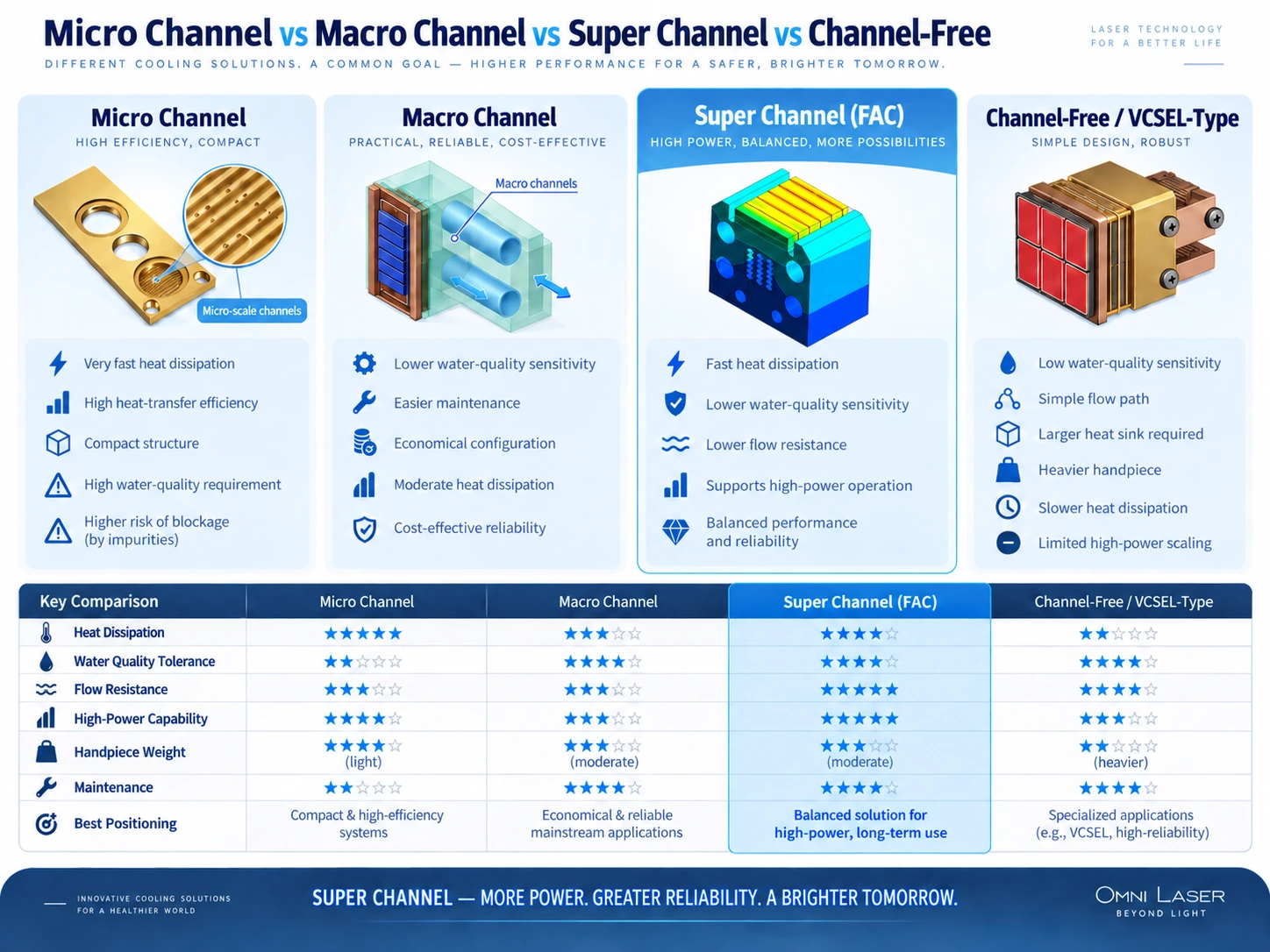
How Super Channel Improves Heat Transfer
Super Channel uses an optimized internal flow path designed to improve contact between cooling water and the heat-transfer surface.
The structure supports:
- Efficient heat removal from the laser module
- Stable water circulation
- Reduced local hot spots
- Lower hydraulic resistance
- Improved thermal uniformity
This is particularly important in high-power diode laser systems, where heat generation increases significantly as laser output rises.
Efficient heat transfer helps maintain a more stable internal operating temperature.
Lower Water-Quality Sensitivity
Water quality is one of the most overlooked factors in diode laser reliability.
In real-world use, customers may use water with different levels of:
- Mineral content
- Dissolved impurities
- Particulate contamination
- Conductivity
- Maintenance quality
Very narrow micro-channels are more sensitive to these differences.
Super Channel uses a more tolerant flow-path architecture, helping reduce the risk of restriction and blockage compared with highly compact micro-channel designs.
This does not mean water quality becomes unimportant.
Professional systems should still use appropriate water and maintenance procedures.
However, improved channel tolerance can make the system more practical for real-world international use.
Super Channel Water Flow Performance
Omni Laser has tested the Super Channel handpiece water circuit under actual operating conditions.
A typical measured flow rate was approximately:
2.7 L/min
This flow level supports stable circulation through the handpiece while maintaining relatively low hydraulic resistance.
The objective is not simply to maximize water flow.
Instead, the system is designed to achieve:
- Sufficient heat removal
- Stable circulation
- Lower water pressure
- Reduced mechanical stress
- Smooth continuous operation
This is important because excessive flow resistance can increase pump load, vibration and operating noise.
Why Low Flow Resistance Matters
Cooling performance depends not only on flow rate, but also on resistance within the water circuit.
A channel with very high resistance may require:
- Higher pump pressure
- Greater pump workload
- More noise
- Higher mechanical stress
- Increased long-term wear
Super Channel is designed to provide efficient heat transfer without requiring excessive water pressure.
This helps support a smoother and more stable cooling circuit.
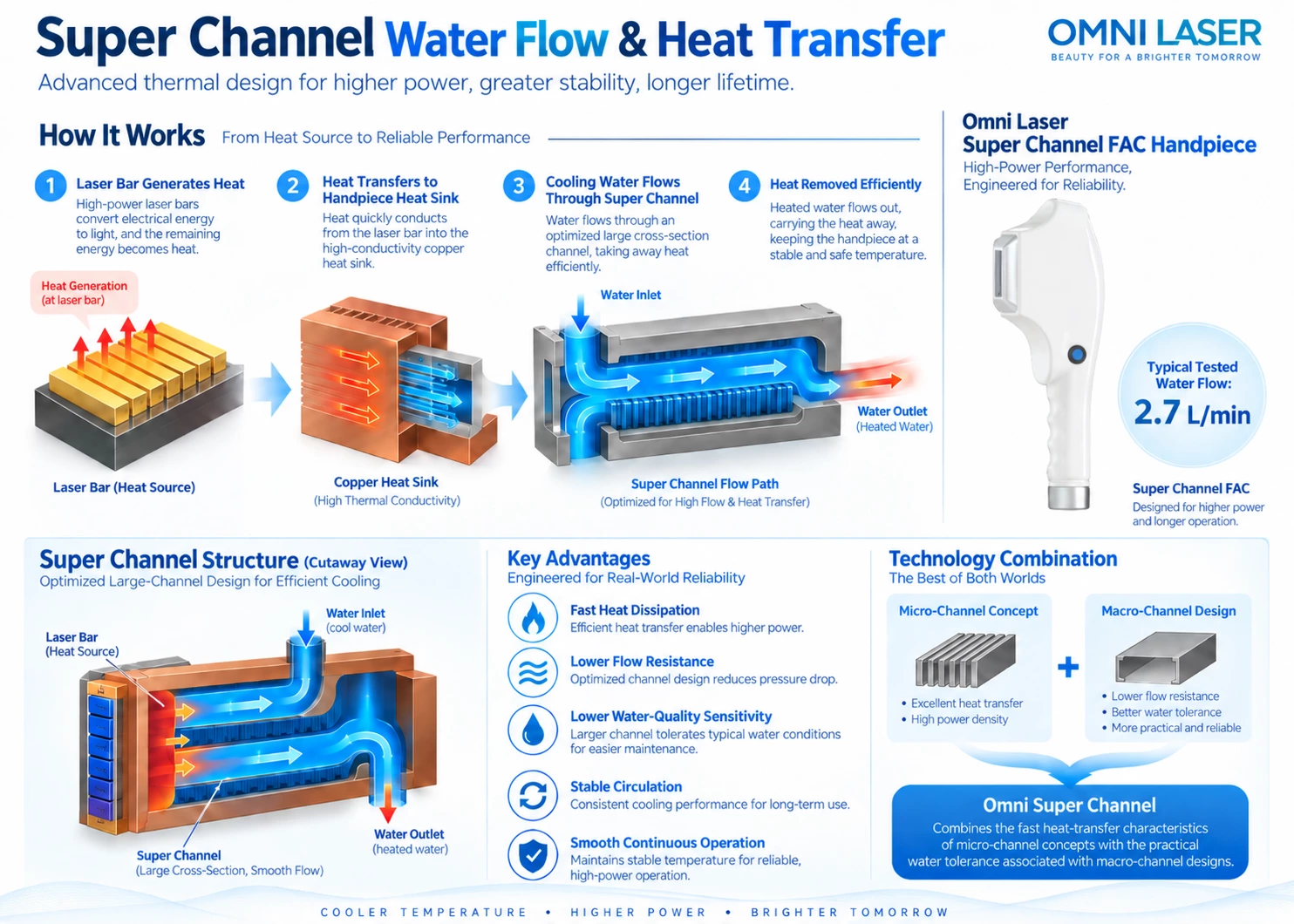
Super Channel vs Micro Channel vs Macro Channel vs Channel-Free
A simplified comparison is shown below:
| Feature | Micro Channel | Macro Channel | Super Channel | Channel-Free |
|---|---|---|---|---|
| Heat Dissipation | Very Fast | Moderate | Fast | Slower |
| Water Quality Tolerance | Low | High | High | Very High |
| Flow Resistance | Higher | Lower | Lower | Very Low |
| High-Power Capability | High | Moderate | High | Limited |
| Handpiece Weight | Light | Medium | Medium | Heavy |
| Maintenance | More Demanding | Easier | Easier | Simple |
| Manufacturing Cost | High | Lower | Medium | Lower |
| Best Positioning | High performance | Cost-effective | Performance + reliability | Simplicity |
The purpose of this comparison is not to classify one technology as universally superior.
Different structures serve different customer needs.
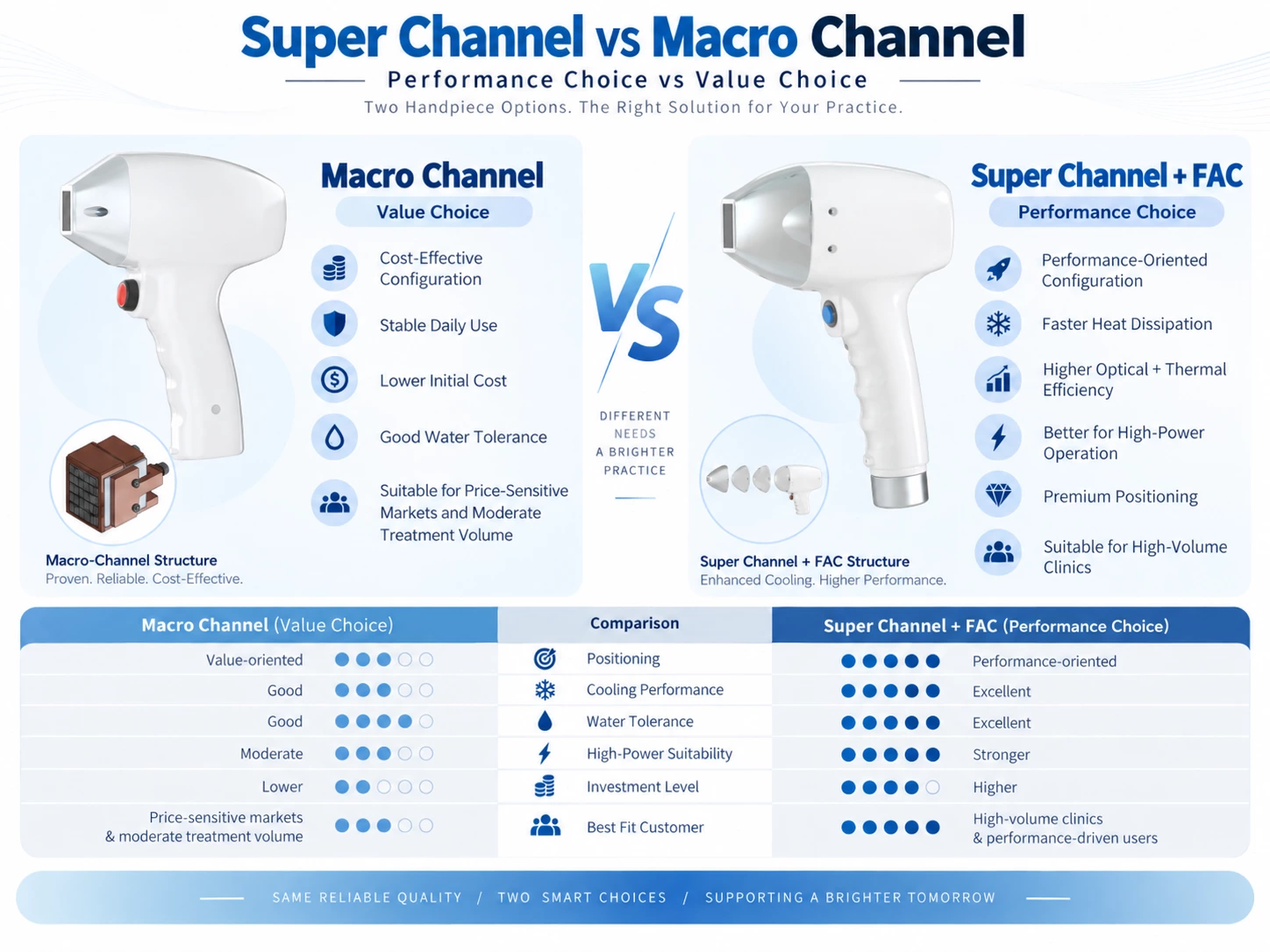
Super Channel vs Macro Channel: Which One Should Customers Choose?
Omni Laser offers both Super Channel and Macro Channel handpiece options.
This allows different customers to select a configuration according to their target market and business model.
Super Channel Handpiece
Best suited for customers who prioritize:
- Higher performance
- Higher power capability
- Faster heat dissipation
- High treatment volume
- Long operating hours
- Premium system positioning
Recommended for:
- High-end clinics
- Busy medical spas
- Professional distributors
- High-volume treatment centers
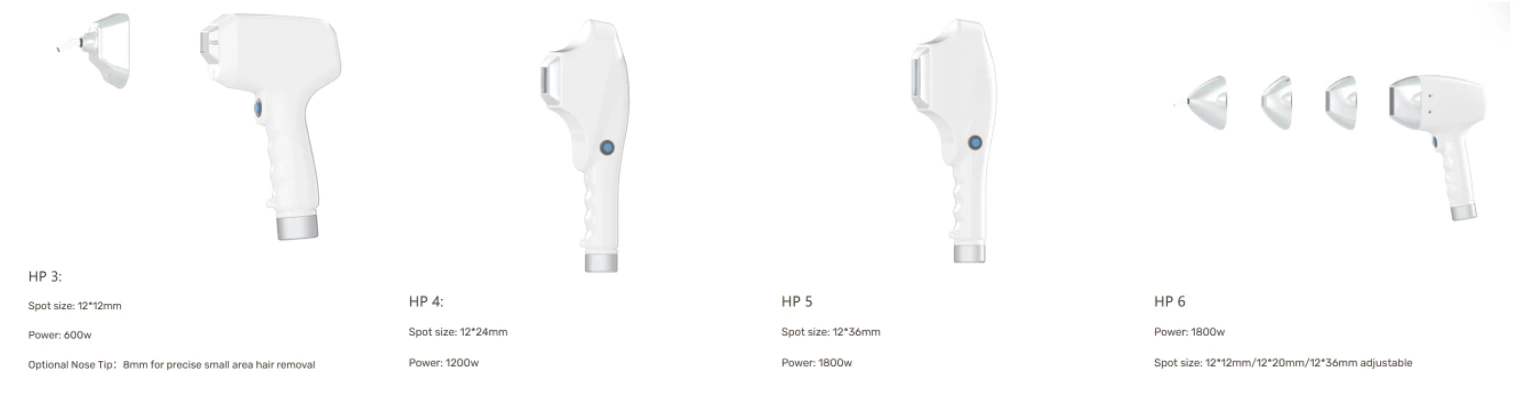
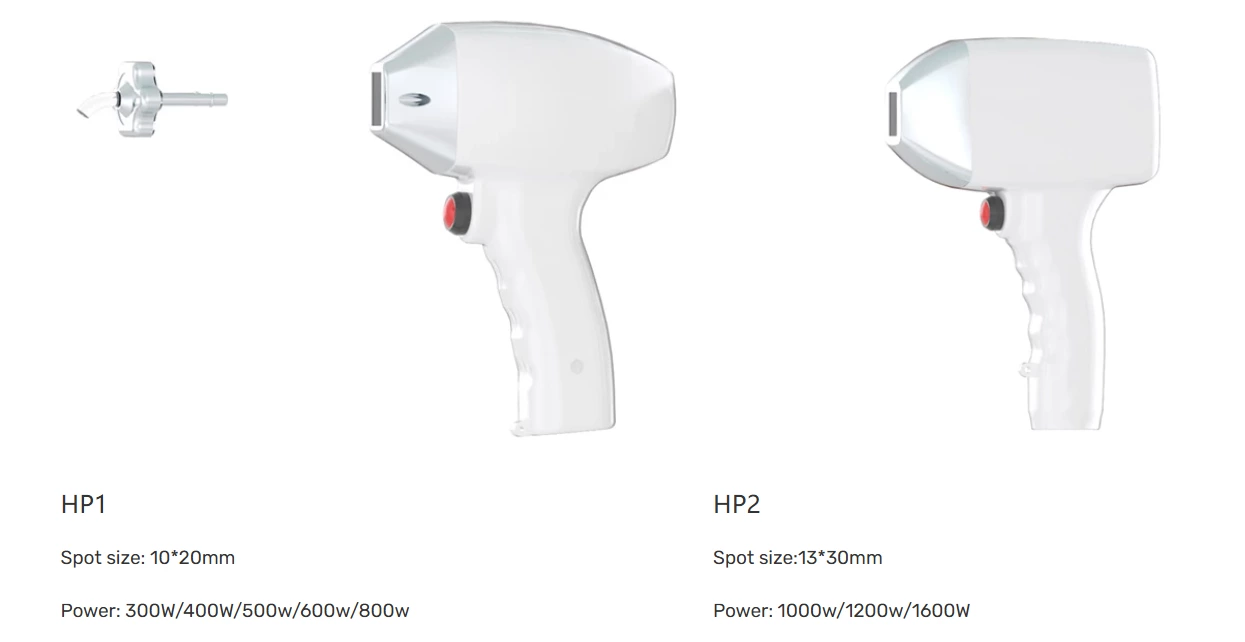
Macro Channel Handpiece
Best suited for customers who prioritize:
- Lower initial cost
- Stable operation
- Lower maintenance sensitivity
- Reliable daily use
- Cost-effective system configuration
Recommended for:
- Price-sensitive markets
- Entry-level professional clinics
- Distributors targeting value segments
- Customers with moderate daily treatment volume
This means the choice is not:
Good vs Bad
but rather:
Performance vs Value
Why Super Channel Is Important for High-Power Diode Laser Systems
As handpiece power increases, thermal load also increases.
High-power laser bars generate more heat and require faster heat transfer.
This makes channel design increasingly important for:
- Output stability
- Cooling efficiency
- Continuous operation
- Laser module protection
- Long-term reliability
Super Channel technology is particularly valuable in high-power configurations where thermal performance becomes a limiting factor.
Super Channel and FAC Technology Work Together
Super Channel and FAC solve two different engineering problems.
FAC Micro-Optical Technology
improves optical energy delivery efficiency.
Super Channel Technology
improves thermal energy removal.
Together:
Efficient Optical Delivery
+
Efficient Heat Removal
support stable high-power operation.
This relationship becomes especially important when the system delivers high effective optical output within shorter pulse durations.
Explore FAC Micro-Optical Technology →
Super Channel and Intelligent Thermal Management
The cooling channel is only one part of the complete thermal-management system.
Stable operation also depends on:
- Water circulation
- Pump performance
- Cooling capacity
- Temperature monitoring
- Active refrigeration
- TEC cooling
- Compressor cooling
These functions are managed by the complete system cooling architecture.
Explore Intelligent Thermal Management System →
Frequently Asked Questions About Super Channel Technology
What is Super Channel technology?
Super Channel is Omni Laser’s optimized diode laser cooling-channel architecture designed to combine fast heat dissipation with lower water-quality sensitivity and stable water circulation.
How is Super Channel different from Micro Channel?
Micro-channel systems use very narrow water channels and can provide excellent heat transfer, but they are more sensitive to water quality and blockage.
Super Channel uses a more tolerant flow path while maintaining fast heat removal.
How is Super Channel different from Macro Channel?
Macro-channel systems use larger channels and offer good water-quality tolerance and reliability, but heat transfer can be slower.
Super Channel is designed to provide faster thermal transfer while maintaining practical water tolerance.
Is Super Channel better than Macro Channel?
Not for every customer.
Super Channel is more suitable for high-performance and high-power applications.
Macro Channel is a more economical solution for customers who prioritize cost, stability and simpler maintenance.
What water flow does the Super Channel handpiece use?
In Omni Laser internal testing, a typical measured flow rate was approximately 2.7 L/min under specified test conditions.
Does Super Channel eliminate the need for good water quality?
No.
Proper water quality and regular maintenance are still important.
Super Channel is designed to be less sensitive to water-quality variation than highly compact micro-channel designs.
Why is channel design important for high-power lasers?
Higher-power laser bars generate more heat.
Efficient channel design helps remove this heat and maintain stable operating temperature.
Super Channel as Part of the Complete Diode Laser Technology System
The complete Omni Laser diode laser technology architecture includes:
Wavelength Selection
→ 755nm / 808nm / 1064nm
Optical Delivery
→ FAC Micro-Optical Technology
Thermal Transfer
→ Super Channel Technology
System Cooling
→ Intelligent Thermal Management
Together, these technologies help support:
- Stable optical output
- Efficient heat removal
- High-power operation
- Reliable continuous use
- Professional treatment performance
Explore the Diode Laser Technology Series
Diode Laser Hair Removal Technology
Understand 755nm, 808nm and 1064nm wavelength characteristics.
FAC Micro-Optical Technology
Learn how optical collimation improves effective optical output.
Intelligent Thermal Management System
Learn how water pumps, TEC cooling, compressor cooling and temperature control work together.
For specific handpiece configurations and diode laser systems:
Explore Omni Laser Diode Laser Hair Removal Systems →
For professional treatment applications: