Русский
 Türkçe
 中文
中文
FAC Micro-Optical Technology for High-Efficiency Diode Laser Energy Delivery
FAC Micro-Optical Technology for High-Efficiency Diode Laser Energy Delivery
In professional diode laser hair removal, rated laser power alone does not fully describe how much useful optical energy actually reaches the treatment path.
Two handpieces may both be rated at 600W, yet deliver significantly different effective optical output depending on beam divergence, optical coupling and internal optical efficiency.
This is where Fast Axis Collimation (FAC) becomes important.
FAC is a precision micro-optical technology designed to reduce the rapid divergence of diode laser light along the fast axis, allowing more of the available laser output to be collected, shaped and delivered through the optical system.
For professional diode laser hair removal systems, FAC can help improve:
- Effective optical output ratio
- Optical utilization efficiency
- Beam delivery efficiency
- Pulse-width flexibility
- Overall system performance
What Is Fast Axis Collimation (FAC)?
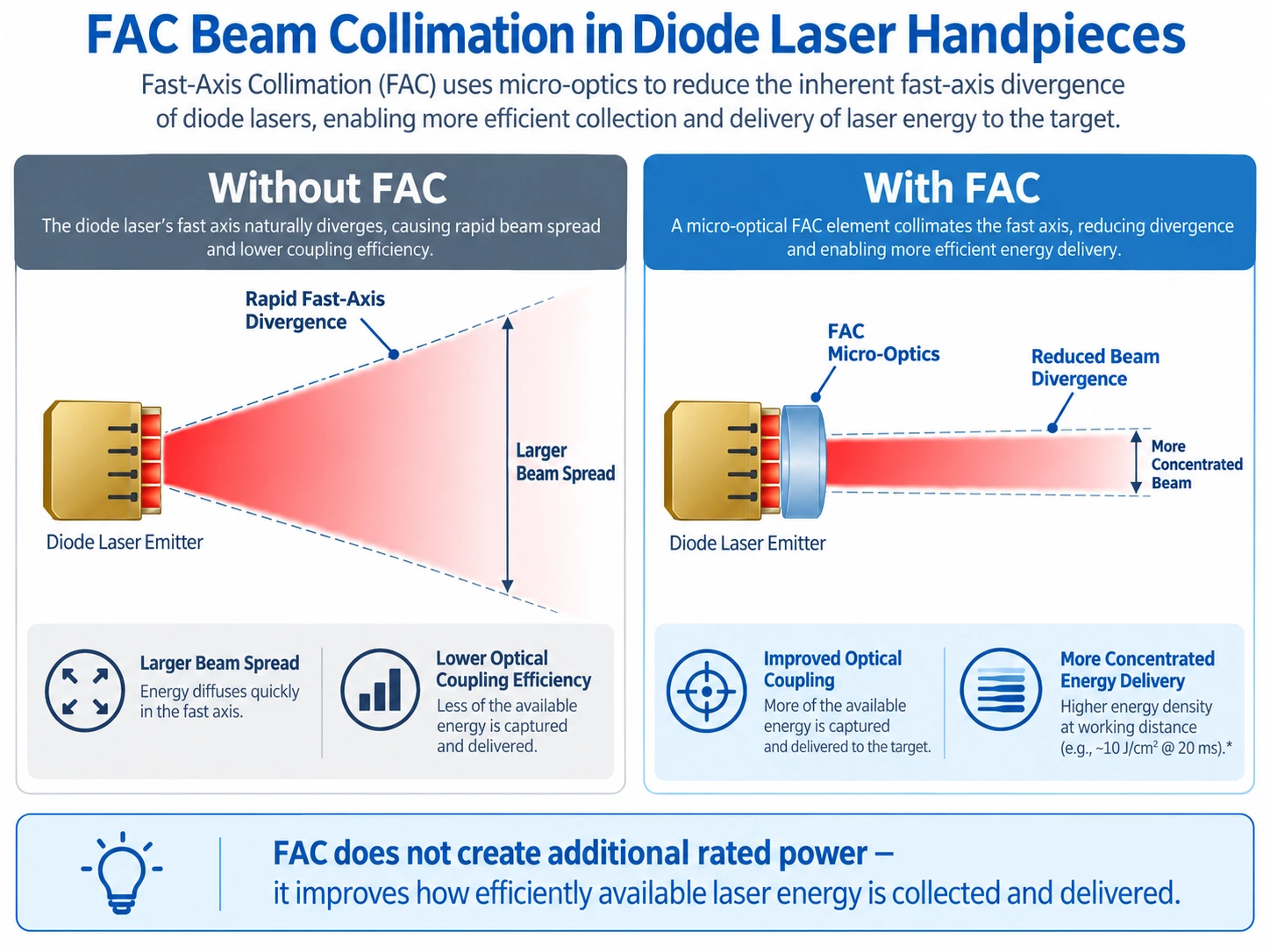
A diode laser emitter naturally produces a highly divergent beam, especially along its fast axis.
Without optical correction, part of the emitted laser energy spreads rapidly and becomes more difficult to collect efficiently into the treatment optical path.
A Fast Axis Collimator is positioned close to the diode laser emitter to reduce this divergence.
In simplified form:
Without FAC
Diode Laser → Rapid Fast-Axis Divergence → Greater Beam Spread → More Optical Loss → Lower Effective Optical Output
With FAC
Diode Laser → FAC Micro-Optics → Reduced Beam Divergence → Improved Optical Coupling → Higher Effective Optical Output
FAC does not create additional rated laser power.
Instead, it improves how efficiently the existing optical power is delivered.
Why Does Beam Divergence Matter?
A diode laser handpiece contains more than a laser source.
The generated optical energy needs to pass through an optical path before it reaches the treatment window.
If the beam diverges too rapidly:
- More energy spreads outside the intended optical path
- Optical coupling becomes less efficient
- More usable energy is lost
- Effective output at the treatment side is reduced
This means:
Rated Laser Power ≠ Effective Optical Output
A 600W laser source does not automatically mean that 600W is being effectively utilized in the treatment optical path.
The real performance depends on the complete optical-delivery architecture.
Rated Power vs Effective Optical Output
This difference can be seen clearly in Omni Laser internal testing.
Under the same rated handpiece power and test conditions:
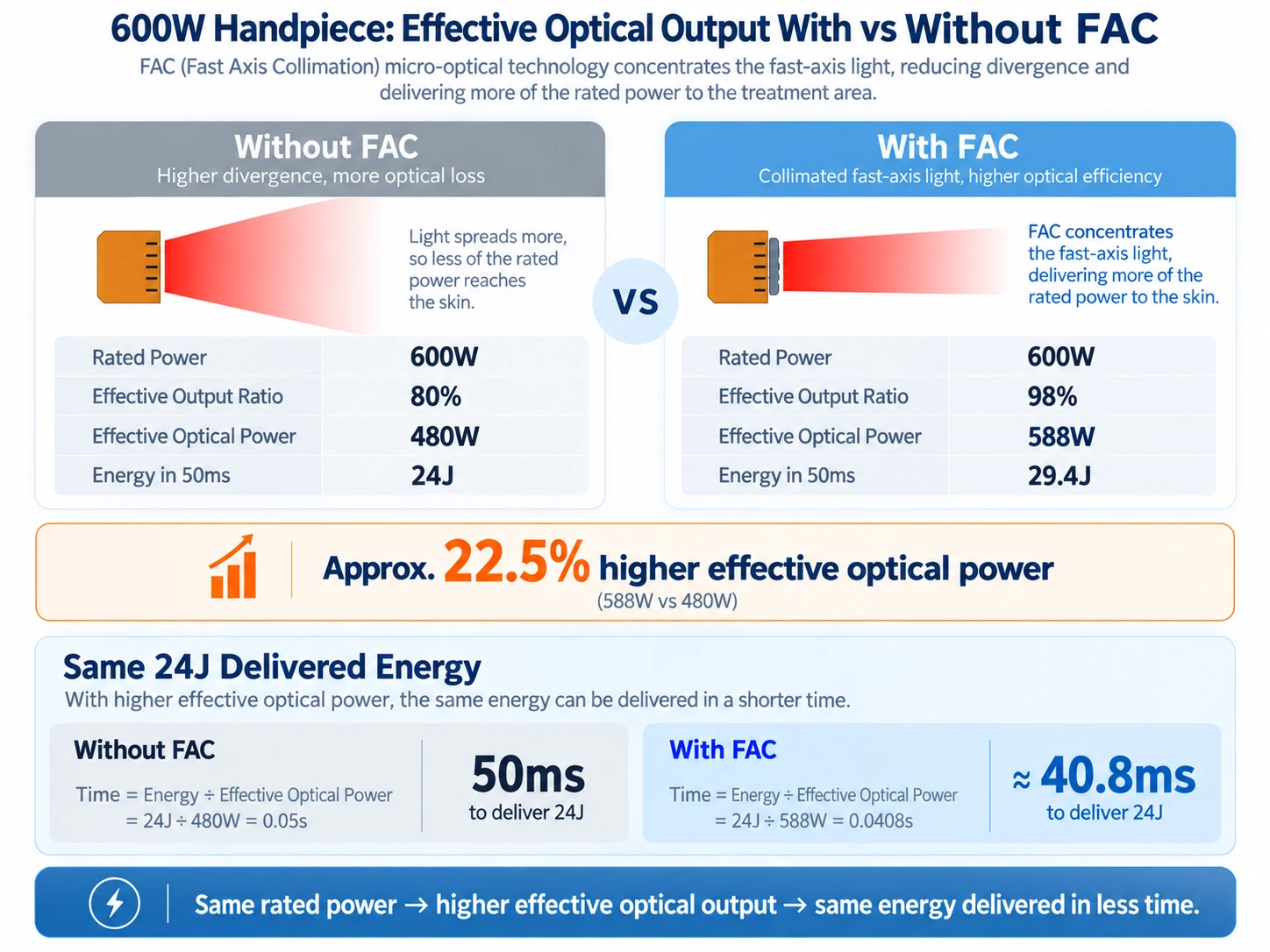
| Test Item | Without FAC | With FAC |
|---|---|---|
| Rated Optical Power | 600W | 600W |
| Tested Effective Output Ratio | 80% | 98% |
| Effective Optical Power | 480W | 588W |
| Energy Delivered in 50ms | 24J | 29.4J |
The calculation is straightforward.
Without FAC
600W × 80% = 480W effective optical power
At a pulse duration of 50ms:
480W × 0.05s = 24J
With FAC
600W × 98% = 588W effective optical power
At the same 50ms pulse duration:
588W × 0.05s = 29.4J
This represents approximately:
22.5% higher effective optical power
compared with the tested non-FAC configuration.
Importantly, this does not mean the rated handpiece power increased from 600W.
The rated laser power remains the same.
The difference comes from improved optical utilization efficiency.
Why Effective Optical Output Matters More Than Rated Power Alone
In professional diode laser systems, customers often compare machines mainly by wattage.
However, rated power is only one part of system performance.
Two 600W handpieces can perform differently if one loses more optical energy through beam divergence and coupling inefficiency.
This is why a more complete technical evaluation should consider:
Rated Power
- Optical Efficiency
- Beam Collimation
- Pulse Control
- Spot Size
- Cooling
- Thermal Management
In other words:
Higher rated power is not enough if a significant portion of the generated optical energy is lost before reaching the treatment path.
FAC technology helps reduce this gap.
How FAC Supports More Efficient Energy Delivery
The practical benefit of FAC is that the required treatment energy can be delivered more efficiently.
For the same:
- Rated laser power
- Spot size
- Treatment area
- Target fluence
a higher effective optical output ratio means the system can deliver the required energy in less time.
The basic relationship is:
Fluence = Power × Pulse Duration ÷ Spot Area
This makes pulse duration an important part of understanding FAC.
How FAC Can Reduce the Pulse Time Required to Deliver the Same Energy
Using the same Omni Laser test example:
Suppose the treatment requires 24J of delivered energy.
Without FAC
Effective Optical Power:
600W × 80% = 480W
Required Pulse Duration:
24J ÷ 480W = 0.050s
= 50ms
With FAC
Effective Optical Power:
600W × 98% = 588W
Required Pulse Duration:
24J ÷ 588W ≈ 0.0408s
= approximately 40.8ms
Therefore:
The same 24J of delivered energy can theoretically be achieved in approximately 40.8ms instead of 50ms under the tested FAC configuration.
This is one of the most important practical advantages of improved optical efficiency.
Same Energy, Less Delivery Time
The relationship can be summarized as:
Same Rated Power
↓
Higher Effective Optical Output Ratio
↓
Higher Effective Optical Power
↓
Same Required Energy Delivered in Less Time
This does not mean shorter pulse duration is always better.
However, it provides the system and operator with greater pulse-width flexibility.
This flexibility becomes valuable when balancing:
- Hair thickness
- Hair pigmentation
- Skin pigmentation
- Fluence
- Spot size
- Thermal relaxation characteristics
- Cooling performance
Why Shorter Pulse Delivery Can Be Useful
Laser hair removal is not only about delivering enough energy. It is also about delivering that energy within an appropriate time window.
This is closely related to the concept of thermal relaxation time (TRT).
Thermal relaxation time describes how quickly a heated structure loses heat to surrounding tissue. Different biological targets have different thermal relaxation characteristics.
In simplified professional terms:
- The epidermis has a relatively short TRT
- Pigmented hair follicles generally have a longer TRT
This difference is highly important in diode laser hair removal.
To achieve selective follicular heating while helping protect the epidermis, pulse duration should be selected according to the thermal characteristics of both the skin surface and the target hair follicle.
In practical terms, pulse-duration selection generally follows two basic principles:
- Long enough to avoid excessive thermal loading of the epidermis
- Short enough to concentrate useful thermal energy within the hair follicle before excessive heat diffusion occurs
This is why pulse duration is not simply a matter of “the shorter the better” or “the longer the safer.”
Instead, the goal is to balance:
- Hair melanin absorption
- Follicular heating
- Epidermal thermal management
- Cooling performance
- Treatment comfort
In many professional discussions, pulse durations such as 10–30ms are often considered useful because they may provide a practical balance between epidermal protection and efficient follicular heating in selected treatment conditions.
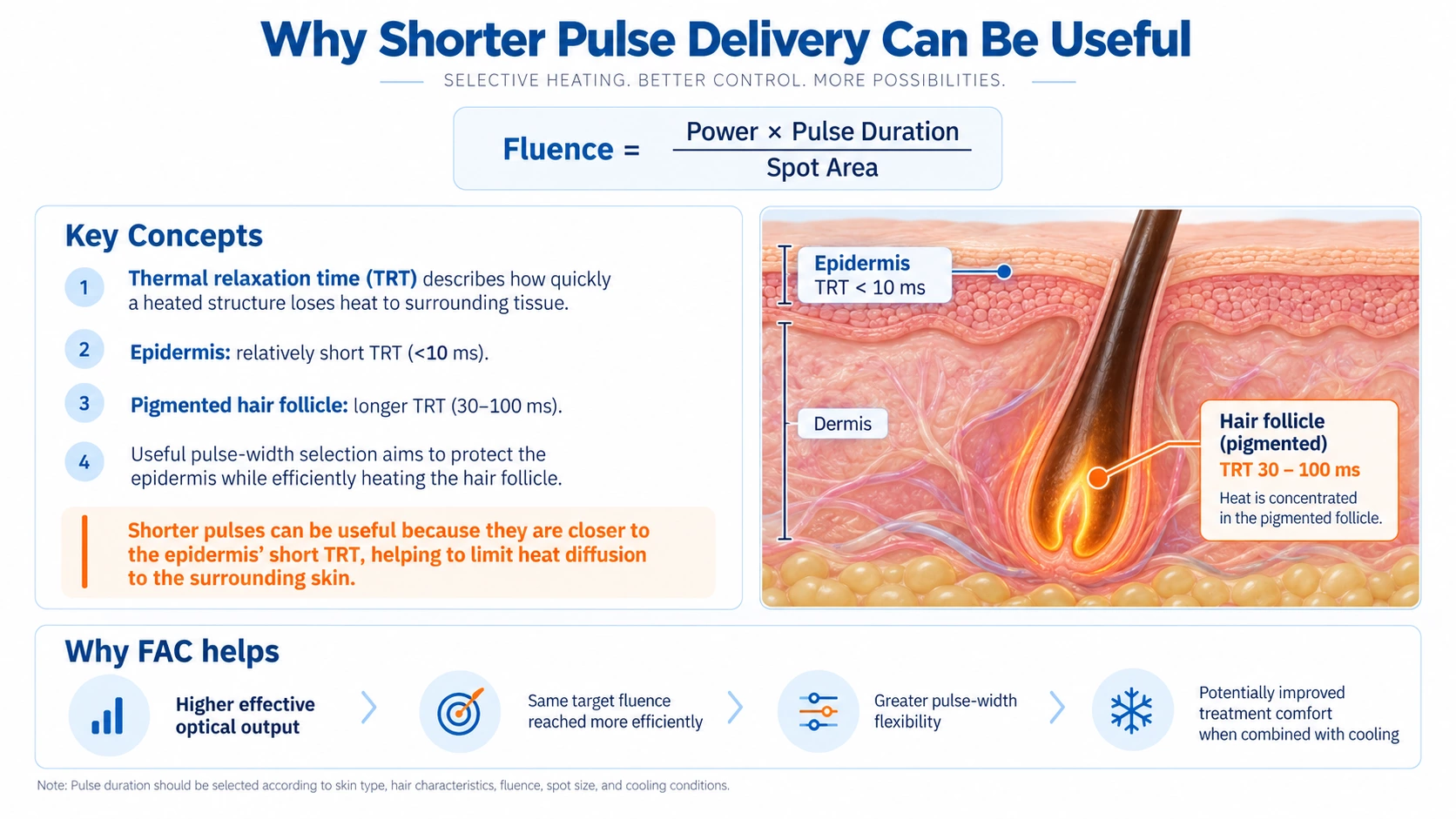
However, the exact setting still depends on:
- Skin type
- Hair characteristics
- Fluence
- Spot size
- Cooling efficiency
- Treatment technique
This is also where FAC Micro-Optical Technology becomes especially valuable.
By improving effective optical output efficiency, FAC allows the required treatment energy to be delivered more efficiently. Under the same rated power and spot size, this provides greater flexibility in achieving the target fluence within a shorter pulse window.
That does not mean shorter pulse duration automatically means painless treatment.
However, when pulse duration is selected according to the target’s thermal relaxation characteristics—and combined with effective surface cooling—more efficient energy delivery can help support:
- Efficient follicular heating
- Reduced unnecessary heat diffusion
- Greater pulse-parameter flexibility
- Improved treatment comfort
In this sense, the value of FAC is not simply “shorter pulse,” but rather:
More efficient energy delivery within a pulse-duration range that better matches the thermal behavior of the target hair follicle and surrounding skin.
FAC and Multi-Wavelength Diode Laser Systems
FAC can also support efficient optical delivery in multi-wavelength diode laser systems.
Professional platforms may use:
- 755nm
- 808nm
- 1064nm
or combinations of these wavelengths.
Different wavelengths have different optical characteristics, but all still depend on efficient beam delivery.
This means wavelength selection and FAC play different roles:
Wavelength Technology
determines melanin interaction and penetration characteristics.
FAC Technology
helps determine how efficiently the generated optical energy is collected and delivered.
Together, they form part of the complete laser-energy delivery architecture.
Explore 755nm, 808nm & 1064nm Diode Laser Technology →
FAC and Cooling Technology Work Together
Improved optical efficiency can increase the amount of useful energy delivered within a given time.
This makes thermal management equally important.
FAC improves optical delivery.
Cooling technology helps manage thermal load.
Professional diode laser systems therefore need to coordinate:
- FAC optical efficiency
- Pulse control
- Sapphire contact cooling
- TEC cooling
- Internal water cooling
- Active thermal management
This allows the system to balance effective optical delivery with controlled operating temperature.
For high-power diode laser configurations, channel design and active cooling architecture become especially important.
Explore Super Channel Technology →
Explore Intelligent Thermal Management System →
Why FAC Is Important for Professional Diode Laser Buyers
For distributors, clinics and OEM/ODM partners, FAC provides an important lesson:
Do not compare diode laser systems by rated wattage alone.
A complete comparison should also consider:
- Effective optical output
- Optical utilization efficiency
- Beam collimation
- Pulse control
- Cooling architecture
- Thermal stability
- Handpiece design
For example, two handpieces may both be labeled 600W, but if one system achieves a substantially higher effective output ratio, the amount of usable optical energy delivered during the same pulse duration can be very different.
This is why optical engineering matters.
Omni Laser FAC Test Data
Omni Laser internal testing showed:
600W Handpiece Without FAC
- Rated Optical Power: 600W
- Effective Output Ratio: approximately 80%
- Effective Optical Power: approximately 480W
- Energy at 50ms: approximately 24J
600W Handpiece With FAC
- Rated Optical Power: 600W
- Effective Output Ratio: up to approximately 98%
- Effective Optical Power: approximately 588W
- Energy at 50ms: approximately 29.4J
The tested FAC configuration therefore achieved approximately:
22.5% higher effective optical power
than the tested non-FAC configuration.
Test Note
Data is based on Omni Laser internal testing under specified handpiece and optical test conditions. Actual performance may vary depending on laser module, wavelength, optical configuration, spot size, operating conditions and measurement method.
Frequently Asked Questions About FAC Technology
What does FAC mean in diode laser technology?
FAC stands for Fast Axis Collimation. It uses precision micro-optics to reduce the rapid divergence of diode laser light along the fast axis.
Does FAC increase the rated laser power?
No. FAC does not increase the rated power of the laser source.
It improves how efficiently the existing optical power is collected and delivered through the treatment optical path.
Why can two 600W handpieces have different effective output?
Because optical losses can differ.
Beam divergence, collimation, coupling efficiency and internal optical design all affect how much of the generated laser power becomes usable optical output.
What effective output ratio did Omni Laser measure?
In Omni Laser internal testing, the non-FAC configuration achieved approximately 80% effective output ratio, while the FAC-equipped configuration reached up to approximately 98% under the specified test conditions.
How much effective optical power does this represent?
For a 600W handpiece:
- 80% effective output = approximately 480W
- 98% effective output = approximately 588W
Can FAC reduce the required pulse duration?
Under the same rated power and target delivered energy, a higher effective optical output ratio can reduce the time required to deliver that energy.
In the Omni Laser test example, 24J required approximately 50ms at 80% output efficiency and approximately 40.8ms at 98%.
Does a shorter pulse automatically mean less pain?
Not exactly, but when the real energy output is more than 10J/cm2 at the pulse on between 10ms to 100ms, the shorter pulse on it is, the less painful it will generates. We should ensure the pulse on more than 10ms, as the Skin TRT time is 10ms.
Treatment comfort depends on the combined effect of pulse duration, fluence, spot size, frequency, skin type, hair characteristics and cooling.
FAC provides greater pulse-width flexibility rather than guaranteeing a painless treatment.
FAC as Part of the Complete Diode Laser Technology System
FAC is one part of a professional diode laser platform.
The complete technology architecture includes:
Wavelength Selection
→ 755nm / 808nm / 1064nm
Optical Delivery
→ FAC Micro-Optical Technology
Pulse Control
→ Fluence / Pulse Duration / Frequency
Thermal Transfer
→ Super Channel Technology
System Cooling
→ Intelligent Thermal Management
Together, these technologies determine how efficiently a diode laser system can generate, deliver and manage optical energy during professional hair-removal operation.
Explore the Diode Laser Technology Series
Diode Laser Hair Removal Technology
Learn how 755nm, 808nm and 1064nm wavelengths interact with hair and skin.
Super Channel Technology
Learn how heat-transfer channel design affects cooling efficiency, water-quality tolerance and high-power laser operation.
Intelligent Thermal Management System
Learn how water circulation, brushless pumps, TEC cooling, compressor cooling and temperature control work together.
For specific systems, handpieces and power configurations:
Explore Omni Laser Diode Laser Hair Removal Systems →
For treatment applications: