Русский
 Türkçe
 中文
中文
Diode Laser Hair Removal Technology: 755nm, 808nm & 1064nm Explained
Diode Laser Hair Removal Technology: 755nm, 808nm & 1064nm Explained
Diode laser hair removal is a professional light-based technology designed for long-term hair reduction by delivering controlled laser energy to pigmented hair structures.
Unlike IPL systems, which use broad-spectrum pulsed light and optical filters, diode laser systems generate selected laser wavelengths. In professional hair removal, commonly used wavelength configurations include 755nm, 808nm and 1064nm.
Each wavelength has different optical characteristics in terms of melanin absorption and penetration depth. By selecting an appropriate wavelength—or combining multiple wavelengths within one system—professional operators can adapt treatment parameters according to different skin types, hair characteristics and treatment areas.
To understand diode laser hair removal, four factors are especially important:
Wavelength → Melanin Absorption → Controlled Thermal Delivery → Hair Follicle Response
What Is Diode Laser Hair Removal Technology?
A diode laser uses semiconductor laser emitters to generate optical energy within a selected wavelength range.
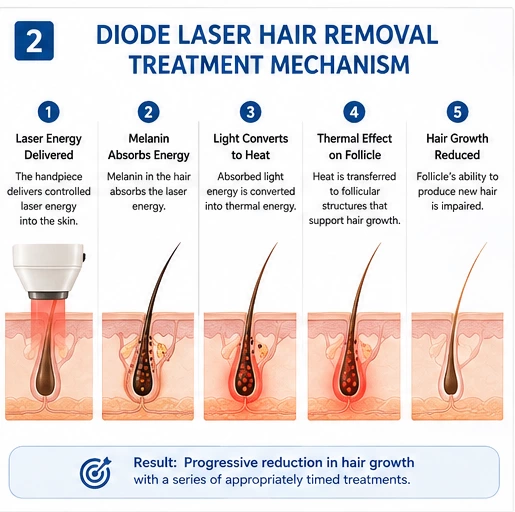
During hair removal treatment, laser energy is delivered through the handpiece and into the skin. Melanin within the pigmented hair structure absorbs part of the optical energy and converts it into heat.
The resulting thermal effect can affect follicular structures involved in hair production, progressively reducing the ability of treated follicles to produce hair.
The basic mechanism can be summarized as:
Diode Laser Energy
↓
Melanin Absorption
↓
Light-to-Heat Conversion
↓
Controlled Follicular Heating
↓
Progressive Hair Reduction
This process is based on an important principle in laser medicine known as selective photothermolysis.
How Does Selective Photothermolysis Work in Laser Hair Removal?
Selective photothermolysis describes the use of an appropriate wavelength, energy level and pulse duration to preferentially heat a selected optical target while limiting unnecessary thermal exposure to surrounding tissue.
In diode laser hair removal, melanin is the primary chromophore.
When laser energy reaches pigmented hair:
- Melanin absorbs part of the laser energy.
- The absorbed optical energy is converted into heat.
- Thermal energy spreads within and around the pigmented hair structure.
- Follicular structures involved in hair production are thermally affected.
- Repeated appropriately timed treatments can progressively reduce hair growth.
This also explains why professional laser hair removal is not simply a question of using the highest possible power.
Effective treatment depends on the relationship between:
Wavelength + Fluence + Pulse Duration + Spot Size + Cooling + Skin & Hair Characteristics
Why Is Melanin Important in Diode Laser Hair Removal?
Melanin is found in both hair and skin.
For laser hair removal, melanin within pigmented hair provides an important optical target. Darker, more highly pigmented hair generally absorbs laser energy more effectively than hair containing very little melanin.
However, melanin is also present in the epidermis.
This creates one of the central challenges of professional laser hair removal:
How can sufficient optical energy be delivered to the target hair while managing thermal exposure to the surrounding skin?
The answer involves selecting appropriate wavelengths and treatment parameters according to the patient's skin and hair characteristics.
This is one reason professional diode laser platforms may use different wavelength configurations rather than relying on one universal setting for every treatment.
755nm vs 808nm vs 1064nm Diode Laser Wavelengths
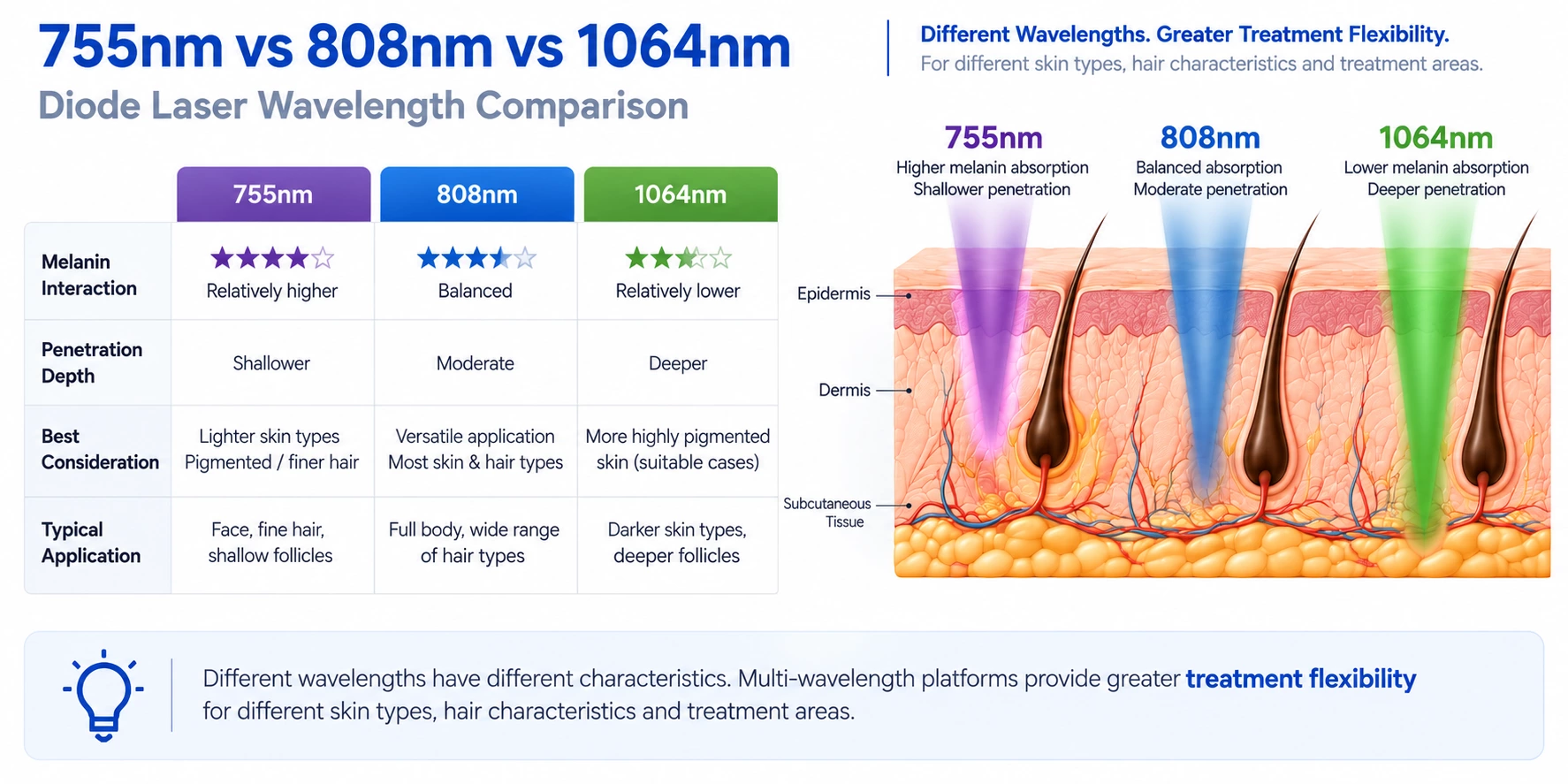
The wavelength of a laser affects both its interaction with melanin and its penetration characteristics in tissue.
For professional diode laser hair removal, 755nm, 808nm and 1064nm represent three commonly used wavelength regions with different optical characteristics.
755nm Diode Laser
755nm has relatively strong interaction with melanin compared with longer near-infrared wavelengths.
This characteristic can make it useful for appropriately selected lighter skin types and pigmented hair, including some finer hair characteristics.
Because epidermal melanin can also absorb optical energy, skin pigmentation needs to be considered carefully when selecting treatment parameters.
Key characteristics of 755nm:
- Relatively strong melanin absorption
- Useful for suitable lighter-skin/hair combinations
- Can support treatment of finer pigmented hair
- Requires appropriate epidermal thermal management
808nm Diode Laser
808nm is one of the most widely used wavelengths in professional diode laser hair removal.
It provides a practical balance between melanin absorption and tissue penetration, making it a versatile wavelength for many professional hair-removal applications.
Key characteristics of 808nm:
- Balanced melanin absorption
- Useful penetration characteristics
- Broad professional hair-removal application
- Commonly used as a core wavelength in diode laser platforms
For this reason, many professional systems use 808nm alone or make it an important component of a multi-wavelength configuration.
It is important, however, to distinguish wavelength selection from optical delivery efficiency. Two 808nm handpieces with the same rated laser power do not necessarily deliver the same amount of usable optical energy through the treatment path.
Optical design, beam collimation and coupling efficiency can significantly influence effective energy delivery.
Learn how FAC Micro-Optical Technology improves diode laser optical delivery efficiency →
1064nm Diode Laser
1064nm is a longer wavelength with deeper penetration characteristics and relatively lower absorption by epidermal melanin compared with shorter wavelengths.
These optical characteristics can provide additional treatment flexibility when working with more highly pigmented skin, provided suitable parameters, cooling and professional protocols are used.
Key characteristics of 1064nm:
- Longer wavelength
- Deeper penetration characteristics
- Relatively lower epidermal melanin absorption
- Additional flexibility for more highly pigmented skin
This does not mean that wavelength alone determines treatment safety or effectiveness. Fluence, pulse duration, cooling, skin assessment and treatment technique remain important.
755nm vs 808nm vs 1064nm: What Is the Difference?
For easier comparison:
| Wavelength | Melanin Interaction | Penetration Characteristic | Typical Professional Consideration |
|---|---|---|---|
| 755nm | Relatively higher | Relatively shallower | Lighter skin and suitable pigmented/finer hair |
| 808nm | Balanced | Moderate | Versatile professional hair-removal applications |
| 1064nm | Relatively lower | Deeper | Additional flexibility for more highly pigmented skin |
The purpose of this comparison is not to identify one wavelength as universally “best.”
Instead:
Different wavelengths provide different optical characteristics that can be selected according to skin type, hair characteristics and treatment objectives.
Why Use 755nm + 808nm + 1064nm in One Diode Laser System?
Human hair is not identical across different patients or even across different areas of the same patient.
Hair can differ in:
- Thickness
- Pigmentation
- Follicle depth
- Density
- Treatment area
Skin pigmentation also varies considerably.
For this reason, multi-wavelength diode laser systems can combine 755nm, 808nm and 1064nm characteristics within one professional platform.
Rather than treating the three wavelengths as competing technologies, a multi-wavelength configuration is designed to provide broader optical flexibility.
In simplified terms:
755nm
→ stronger melanin interaction
808nm
→ balanced absorption and penetration
1064nm
→ deeper penetration and lower relative epidermal melanin absorption
Combined within one professional platform:
755nm + 808nm + 1064nm = Greater Wavelength Flexibility
The appropriate treatment settings still need to be selected according to the individual skin and hair characteristics.
What Parameters Affect Diode Laser Energy Delivery?
Wavelength alone does not determine the performance of a professional diode laser.
Several parameters work together.
| Parameter | Function | Why It Matters |
|---|---|---|
| Wavelength | Determines optical absorption and penetration characteristics | Influences interaction with hair and skin |
| Fluence | Energy delivered per unit area | Influences treatment intensity |
| Pulse Duration | Determines how long energy is delivered | Influences thermal delivery |
| Frequency | Determines pulse repetition rate | Influences operating speed and technique |
| Spot Size | Determines treatment area | Influences coverage and optical delivery |
| Cooling | Manages treatment-surface temperature | Supports epidermal thermal management and comfort |
| Optical Efficiency | Determines how efficiently generated laser energy reaches the treatment path | Influences usable energy delivery |
This last factor—optical efficiency—is particularly important.
A handpiece can have a high rated laser power while losing part of the available optical energy through beam divergence or inefficient optical coupling.
This is why professional system evaluation should consider more than wattage alone.
Explore FAC Micro-Optical Technology →
Why Is Pulse Duration Important?
Pulse duration determines how long laser energy is delivered during each pulse.
Once melanin absorbs the optical energy, heat begins to transfer through the targeted hair structure and surrounding tissue.
Professional diode laser systems therefore provide adjustable pulse durations to help balance energy delivery according to:
- Hair thickness
- Hair pigmentation
- Skin pigmentation
- Fluence
- Treatment area
- Cooling performance
A shorter pulse is not automatically better, and a longer pulse is not automatically safer.
The appropriate pulse duration needs to be considered together with the target's thermal characteristics and the other treatment parameters.
Efficient optical delivery can also provide greater flexibility in how quickly the required energy is delivered.
For a deeper explanation of this relationship:
Read FAC Micro-Optical Technology →
Why Is Cooling Important in Diode Laser Hair Removal?
Diode laser hair removal intentionally generates thermal energy around pigmented hair structures.
At the same time, excessive heat accumulation within the epidermis or laser system needs to be controlled.
Professional diode laser platforms therefore require two different types of thermal management:
Treatment-Surface Cooling
Cooling at the treatment window helps manage epidermal temperature and treatment comfort.
Internal Laser-System Cooling
The laser module itself generates heat during operation. Water circulation, heat-transfer architecture and active cooling are therefore required to maintain suitable operating conditions.
For high-power diode laser systems, the design of the cooling channel can significantly influence heat-transfer efficiency, water-flow requirements and long-term system stability.
Explore Super Channel Diode Laser Technology →
And for the complete cooling architecture:
Explore Intelligent Thermal Management for Professional Diode Lasers →
Does Higher Diode Laser Power Always Mean Better Performance?
No.
Rated handpiece power is an important specification, but it does not independently determine the quality of laser energy delivered to the treatment area.
Professional diode laser performance also depends on:
Laser Source
- Wavelength Configuration
- Optical Efficiency
- Pulse Control
- Spot Size
- Thermal Management
- System Engineering
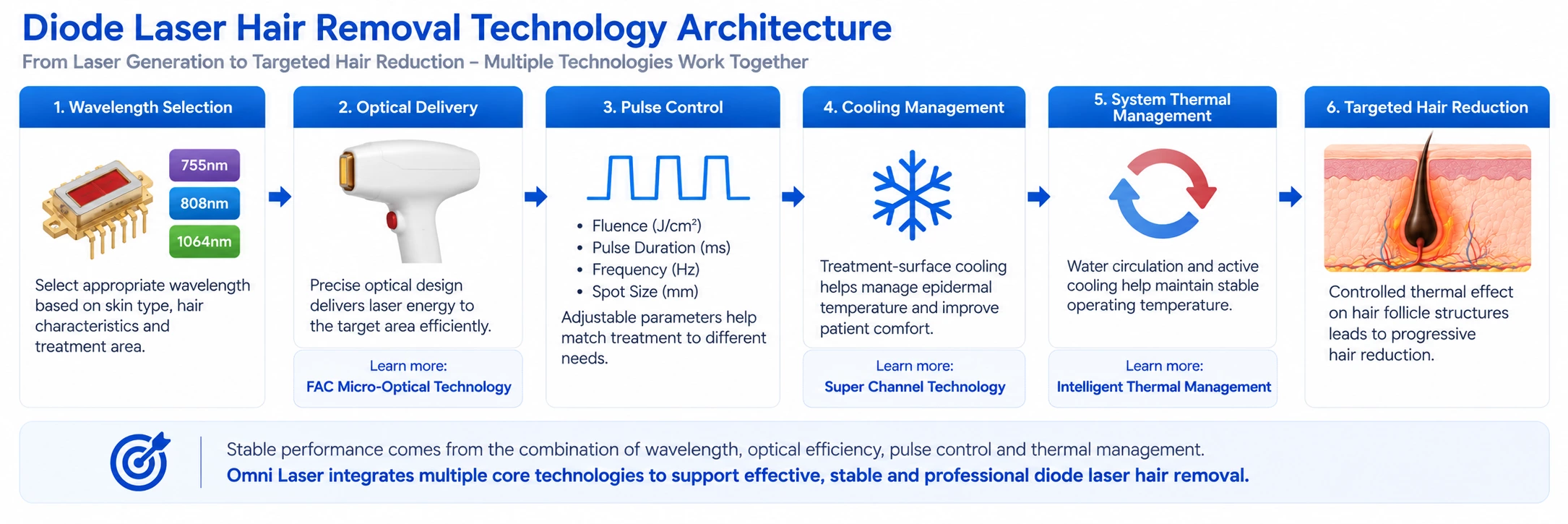
For example, two handpieces may both be rated at 600W while differing in optical losses and effective output through the treatment optical path.
Therefore:
Rated Power tells you how much optical power the laser source is designed to produce. Optical efficiency helps determine how much of that power can be effectively utilized.
The detailed engineering behind this difference is covered in our FAC technology article.
Diode Laser vs IPL: What Is the Technology Difference?
Both diode laser and IPL can be used for professional hair reduction, but they generate and deliver light differently.
| Diode Laser | IPL | |
|---|---|---|
| Light Source | Semiconductor laser | Xenon flash lamp |
| Optical Output | Selected laser wavelength(s) | Broad-spectrum pulsed light |
| Typical Hair Removal Wavelength | 755 / 808 / 1064nm configurations | Filter-selected wavelength bands |
| Primary Positioning | Dedicated hair-reduction platform | Multifunctional aesthetic platform |
| Other Skin Applications | Primarily hair focused | Rejuvenation, pigmentation, acne and vascular applications depending on configuration |
For clinics where hair removal is the primary treatment service, diode laser provides a dedicated laser platform.
For clinics seeking hair removal together with multiple skin-treatment applications, IPL provides a different type of treatment platform.
Explore Professional IPL Technology →
Frequently Asked Questions About Diode Laser Hair Removal Technology
What is diode laser hair removal technology?
Diode laser hair removal uses selected laser wavelengths to deliver controlled optical energy to pigmented hair structures. Melanin absorbs the energy and converts it into heat, creating a thermal effect around follicular structures involved in hair growth.
Why is 808nm commonly used for laser hair removal?
808nm provides a practical balance between melanin absorption and tissue penetration, which is why it is widely used in professional diode laser hair-removal systems.
What is the difference between 755nm, 808nm and 1064nm?
The three wavelengths differ in their melanin interaction and penetration characteristics. 755nm provides relatively stronger melanin interaction, 808nm offers a versatile balance, and 1064nm provides deeper penetration with relatively lower epidermal melanin absorption.
Why combine three wavelengths?
Combining 755nm, 808nm and 1064nm provides greater optical flexibility for different combinations of skin pigmentation, hair characteristics and treatment requirements.
Is higher wattage always better?
No. Rated power is only one part of system performance. Optical efficiency, wavelength, pulse control, spot size, cooling and overall engineering also affect effective laser-energy delivery.
What is the difference between diode laser and IPL hair removal?
Diode laser uses selected laser wavelengths and is primarily designed as a dedicated hair-reduction platform. IPL uses filtered broad-spectrum pulsed light and can support hair removal together with multiple skin-treatment applications.
Explore the Diode Laser Technology Series
To understand the engineering behind a professional diode laser system in greater depth:
FAC Micro-Optical Technology
Learn how beam collimation and optical efficiency affect effective laser output.
Super Channel Diode Laser Technology
Learn how cooling-channel architecture affects heat transfer, water-flow requirements and high-power laser operation.
Intelligent Thermal Management System
Learn how water circulation, brushless pumps, TEC cooling, compressor cooling and temperature control work together.
For treatment applications, hair-growth cycles and professional treatment planning:
Explore Diode Laser Hair Removal Treatment →
For system models, wavelength configurations, handpieces and professional clinic solutions: