Русский
 Türkçe
 中文
中文
IPL (Part 4)|The Real Performance Gap in Handheld IPL Devices?
The Five Performance Levels of Handheld & Mini IPL Devices on the Market
With the rapid expansion of the at-home beauty device market, handheld and Mini IPL devices are now widely available across different price ranges and brands.
However, not all IPL devices deliver the same level of results, even if they share similar appearances or marketing claims.
From an engineering and clinical-effectiveness perspective, most handheld IPL devices on the market can be categorized into five distinct levels.
The differences between these levels lie primarily in optical structure, energy delivery capability, and effective treatment coverage.
Level 1: Low-Power Light Devices (Cosmetic-Level)
Manufacturing Characteristics
-
Light source: Low-power xenon or LED-like pulsed light
-
Optical structure: Simplified or non-professional
-
Cooling system: None
-
Pulse control: Basic or non-existent
Typical Performance Range
-
Energy output: 8J/cm²
-
Spot size: 3cm²
Effectiveness Evaluation
Devices in this category do not meet the energy threshold required for selective photothermal interaction with hair follicles or chromophores.
They may emit visible light but lack true IPL therapeutic capability.
Conclusion
❌ Not clinically effective
❌ Primarily cosmetic or decorative devices
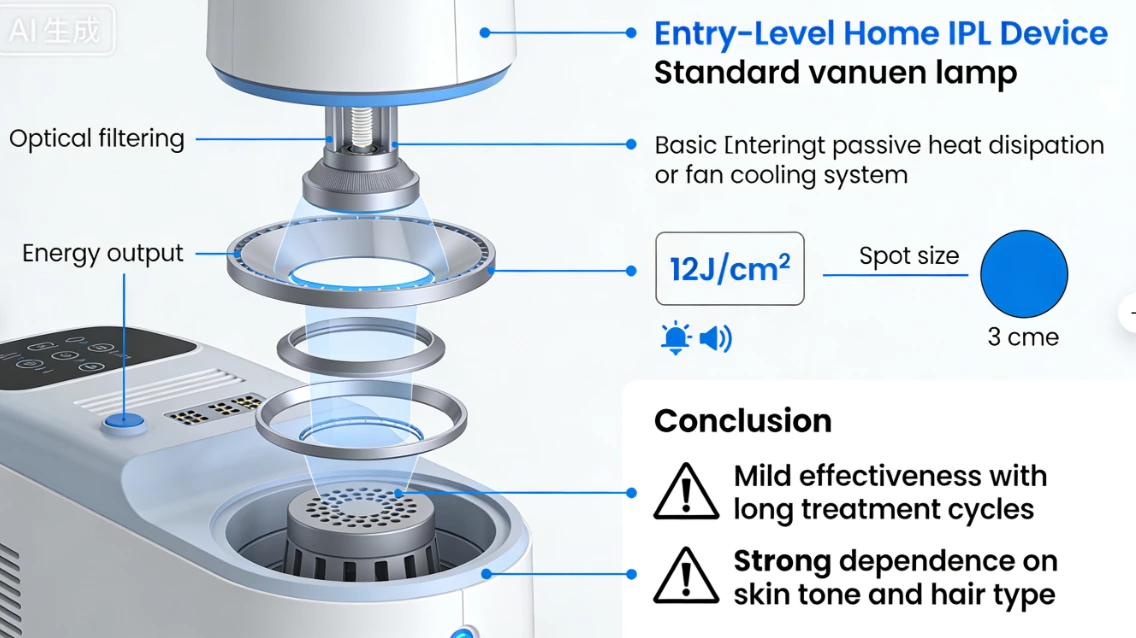
Level 2: Entry-Level Home IPL Devices
Manufacturing Characteristics
-
Standard xenon lamp
-
Basic optical filtering
-
Passive heat dissipation or fan cooling
Typical Performance Range
-
Energy output: 12J/cm²
-
Spot size: 3 cm²
Effectiveness Evaluation
This level represents early-generation home IPL devices. While safer for general consumers, their conservative energy design results in slow and limited results, especially for coarse or dense hair.
Conclusion
⚠️ Mild effectiveness with long treatment cycles
⚠️ Strong dependence on skin tone and hair type
Level 3: Enhanced Home IPL Devices
Manufacturing Characteristics
-
Improved lamp quality and optical path
-
More stable pulse control
-
Entry-level contact cooling
Typical Performance Range
-
Energy output: 12J/cm²
-
Spot size: 3cm²
Effectiveness Evaluation
Devices at this level begin to approach the lower boundary of effective photothermal response.
Some users may observe noticeable hair reduction after consistent use, though results vary significantly.
Conclusion
✅ Moderately effective for selected users
⚠️ Still clearly below professional IPL performance
Level 4: Near-Professional Mini IPL Devices
Manufacturing Characteristics
-
Optimized optical structure
-
Sapphire + TEC cooling
-
Multi-pulse or energy-balanced output
Typical Performance Range
-
Energy output: 12J/cm²
-
Spot size: 3 cm²
Effectiveness Evaluation
This level marks the transition where handheld IPL devices begin to replicate core elements of professional IPL systems, achieving stronger and more consistent outcomes.
Conclusion
✅ Clinically meaningful effectiveness
✅ Shorter treatment cycles and better comfort
Level 5: Engineering-Grade Mini IPL Systems
Manufacturing Characteristics
-
Professional-grade optical engine
-
Sapphire + TEC cooling
-
Precise control of pulse width and repetition rate
Typical Performance Range
-
Energy output: 15-18J/cm²
-
Spot size: 3 cm²
Effectiveness Evaluation
These devices are designed with professional IPL logic scaled down, rather than simplified home-device architecture.
They offer the closest at-home experience to in-clinic IPL treatments.
Conclusion
✅ Highly effective
✅ True bridge between commercial and home IPL technology
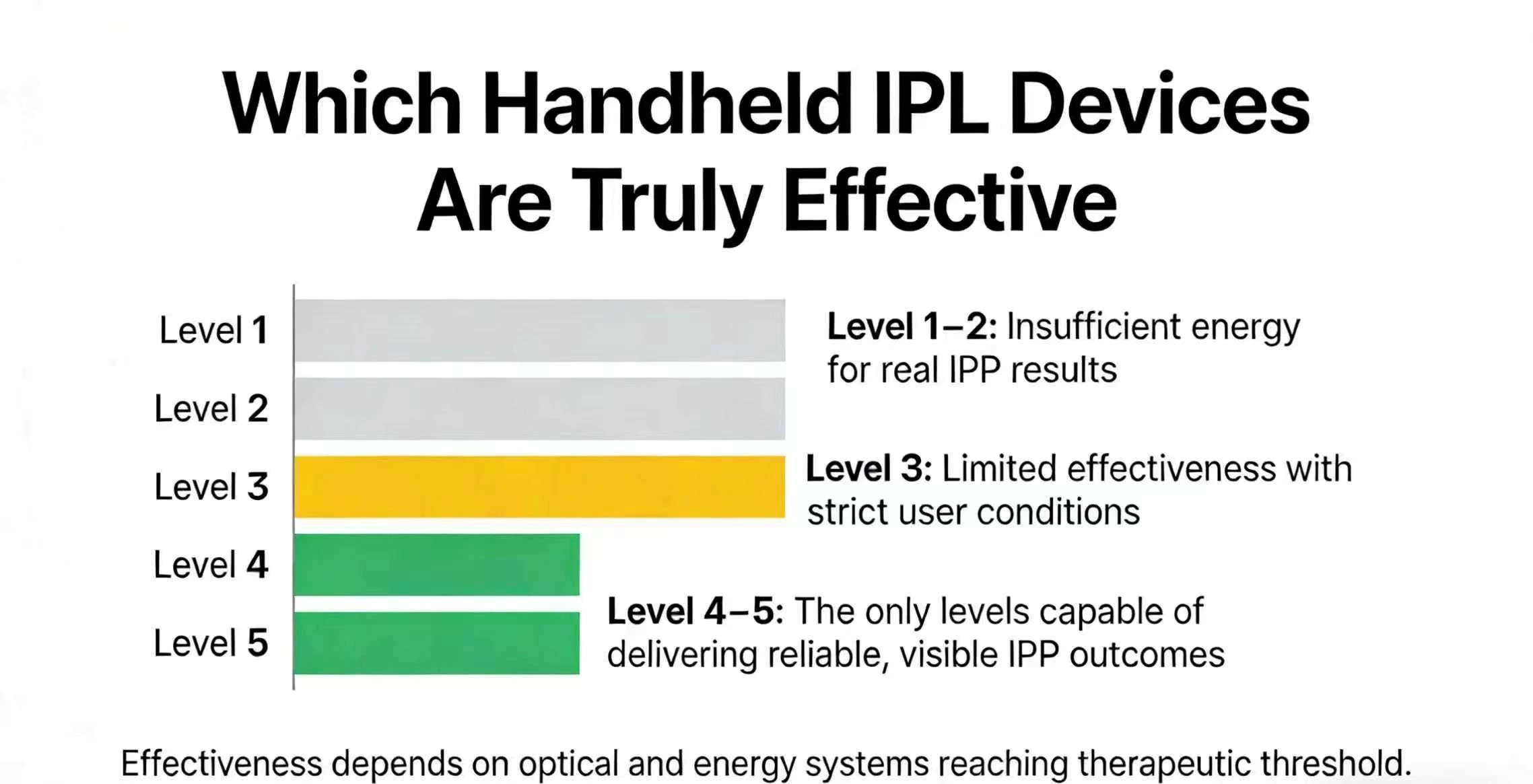
Summary: Which Handheld IPL Devices Are Truly Effective?
-
Level 1–2: Insufficient energy for real IPL results
-
Level 3: Limited effectiveness with strict user conditions
-
Level 4–5: The only levels capable of delivering reliable, visible IPL outcomes
Effectiveness depends not on whether a device is labeled “home” or “professional,” but on whether its optical and energy systems reach the required therapeutic threshold.
The Advantages and Common Limitations of Existing Handheld IPL Devices
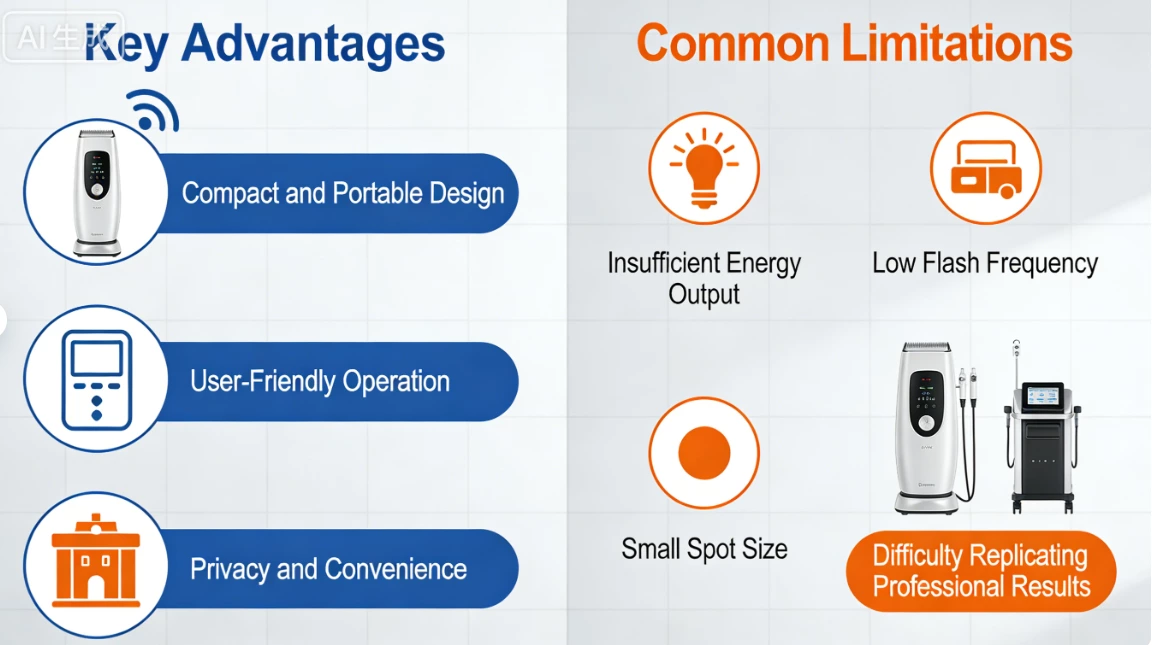
Key Advantages of Handheld IPL Devices
Compact and Portable Design
Handheld IPL devices are lightweight and easy to store or carry, making them suitable for modern, mobile lifestyles.
User-Friendly Operation
Simplified interfaces and preset parameters allow non-professional users to perform treatments safely at home.
Privacy and Convenience
At-home IPL enables users to manage hair removal or skin care discreetly without clinic appointments or time constraints.
Common Limitations Across the Market
Insufficient Energy Output
Many handheld IPL devices are designed with conservative energy limits, resulting in slow treatment progress and inconsistent outcomes.
Low Flash Frequency
Slow pulse repetition significantly increases treatment time, reducing overall usability.
Small Spot Size
Limited treatment coverage leads to lower efficiency, especially for large areas such as legs or back.
Difficulty Replicating Professional Results
Due to size and thermal constraints, most handheld devices struggle to match the comfort, speed, and effectiveness of commercial IPL systems.
Closing Insight
The handheld IPL market is not defined by whether devices work—but by how well they work.
Only devices that successfully balance energy density, optical efficiency, cooling, and spot size can move beyond convenience and deliver real results.
This performance gap is precisely what defines the next phase of Mini IPL development.
👉 In the next article, we will explore how advanced engineering approaches are enabling Mini IPL systems to overcome these limitations and approach professional-level performance.