Русский
 Türkçe
 中文
中文
Blue LED Light Therapy for Acne-Prone and Oily Skin
Introduction
Blue LED light therapy is widely used in professional aesthetic skin-care programs for acne-prone, oily and blemish-prone skin.
By delivering controlled visible blue light to the skin, professional LED phototherapy systems provide a non-invasive way to support clearer-looking skin and a more balanced complexion without relying on ablative or thermal treatment.
Professional blue LED systems may use different wavelengths depending on device design and intended application. Shorter blue wavelengths around 405–420nm, particularly approximately 415nm, have been extensively investigated in acne-related phototherapy research.
Longer blue wavelengths, including 469nm, can also be incorporated into professional multi-wavelength aesthetic systems for skin-conditioning programs.
However, different blue wavelengths should not automatically be considered equivalent. Published acne-related clinical studies are concentrated primarily around approximately 405–450nm, while direct clinical evidence specifically for 469nm is more limited.
What Is Blue LED Light Therapy?
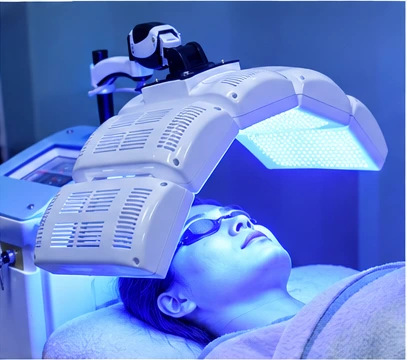
Blue LED light therapy uses arrays of light-emitting diodes to deliver selected wavelengths within the visible blue portion of the light spectrum.
Unlike a laser, LED systems typically provide broader-area illumination, making them particularly suitable for full-face aesthetic treatments.
Professional systems can be designed with different blue wavelengths depending on the desired skin-care program.
Common examples include:
405–420nm
Frequently studied for acne-prone and blemish-prone skin.
415nm
One of the best-known blue wavelengths in acne-related LED research.
446–450nm
Longer blue wavelengths that have also appeared in clinical research.
469nm
A longer visible blue wavelength that can be incorporated into professional LED skin-care systems for broader aesthetic skin-conditioning programs.
The important point for clinics is that “blue light” is not one single wavelength.
A professional LED system should therefore clearly identify its actual wavelength rather than simply labeling the treatment mode as “Blue.”
Why Is Blue Light Used for Acne-Prone Skin?
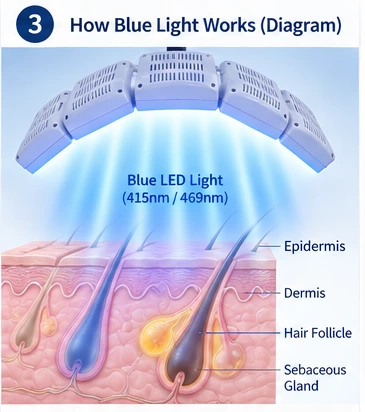
One of the reasons blue light has received significant attention in acne-prone skin care is its interaction with naturally occurring porphyrins associated with Cutibacterium acnes.
These porphyrins absorb blue light, with strong absorption occurring near approximately 415nm.
This interaction is one reason why 405–420nm light appears frequently in published acne-related phototherapy studies. Clinical literature has generally found better responses in inflammatory acne lesions than in purely non-inflammatory comedonal lesions, although treatment outcomes vary significantly among protocols.
For an aesthetic equipment website, however, it is more appropriate to position blue LED therapy as supporting:
- acne-prone skin care
- blemish-prone skin care
- skin clarity
- oily and combination skin management
- professional facial conditioning
rather than presenting blue LED therapy as a guaranteed medical cure for acne.
Key Aesthetic Applications of Blue LED Light
Acne-Prone Skin Care
Blue LED light is commonly incorporated into professional facial programs designed for clients with acne-prone and blemish-prone skin.
The goal in aesthetic practice is generally to support a clearer and more balanced-looking complexion while incorporating LED therapy into a broader professional skin-management program.
Blemish-Prone Skin
Some clients may not have clinically diagnosed acne but frequently experience visible blemishes or congestion.
Blue LED light can be incorporated into professional facial programs for these clients as part of a broader approach combining cleansing, skin preparation and light-based care.
Oily and Combination Skin
Oily skin commonly overlaps with blemish-prone and congested-looking skin.
Blue LED therapy can therefore be incorporated into professional programs for:
- oily-looking skin
- combination skin
- visibly congested skin
- blemish-prone facial areas
However, it is better not to claim that blue light alone permanently reduces sebum production.
Studies examining blue light have used very different wavelengths, doses and protocols, and evidence for direct sebaceous effects is not uniform across blue-light devices.
Skin Clarity and Overall Balance
For professional medical-aesthetic skin care, blue LED therapy can also be positioned around:
clearer-looking skin
more balanced skin appearance
reduced appearance of recurring blemishes
fresh-looking complexion
This keeps the application within a professional aesthetic context without over-medicalizing the treatment.
415nm and 469nm Blue LED Light: What Is the Difference?
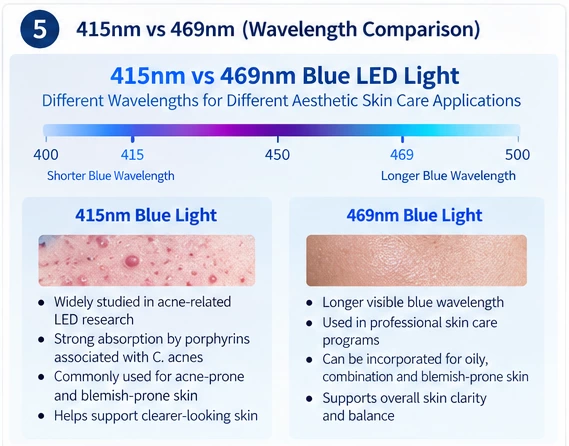
415nm Blue LED Light
Approximately 415nm is one of the most widely recognized blue wavelengths in acne-related phototherapy research.
This is largely because porphyrins associated with C. acnes absorb blue light strongly around this region.
Multiple clinical studies and reviews have investigated approximately:
405–420nm
414nm
415nm
415–446nm
for acne-related applications.
For this reason, 415nm is particularly relevant when the professional program is focused primarily on:
- acne-prone skin
- inflammatory blemish-prone skin
- skin clarity
- professional acne-care facial programs
469nm Blue LED Light
469nm sits further toward the longer-wavelength end of the visible blue spectrum.
It remains blue visible light, but its optical characteristics differ from 415nm.
For Omni Laser products equipped with 469nm blue LED light, it is more appropriate to position this wavelength around:
- professional blue-light skin care
- oily or combination skin programs
- blemish-prone skin conditioning
- skin clarity
- multi-wavelength facial programs
rather than making the specific claim that:
469nm has the same acne-related biological effect as 415nm.
At present, the published acne literature is considerably stronger around shorter blue wavelengths up to approximately 450nm.
This distinction actually makes your website look more professional, because you are explaining the real difference rather than pretending that every blue LED wavelength is identical.
Is 415nm Better Than 469nm?
I would not recommend writing:
415nm is better than 469nm
because “better” depends on the intended aesthetic program.
A better explanation is:
415nm
More strongly associated with published acne-prone skin research.
469nm
A longer blue wavelength suitable for broader professional blue-light skin-conditioning programs.
The final skin response also depends on:
- wavelength
- irradiance
- energy density
- treatment distance
- exposure time
- LED distribution
- treatment area
- treatment frequency
So wavelength alone should never be used to judge the overall performance of a professional LED device.
Who Is Blue LED Light Therapy Suitable For?
Within professional aesthetic skin care, blue LED programs may be considered for clients concerned with:
- acne-prone skin
- blemish-prone skin
- oily-looking skin
- combination skin
- congested-looking complexion
- recurring visible blemishes
- uneven-looking skin clarity
- professional facial maintenance
Treatment selection should always take into account the client's individual skin condition and the actual wavelength and output parameters of the LED device.
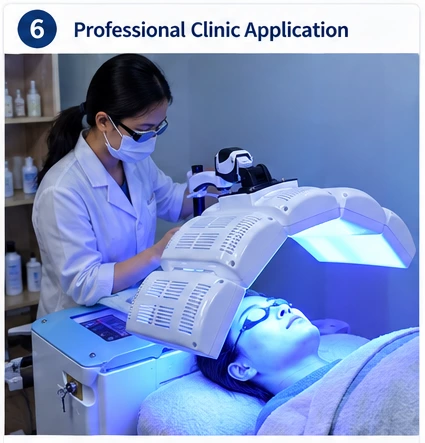
How Is Blue LED Therapy Used in Professional Aesthetic Clinics?
Standalone Blue LED Facial Program
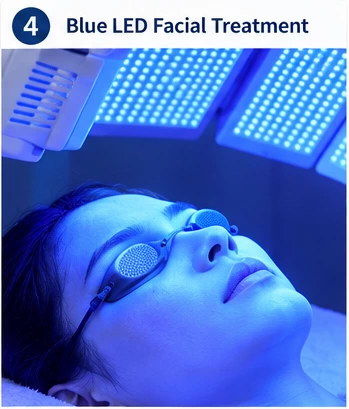
Blue LED light may be used as a standalone non-invasive light-based program for acne-prone or blemish-prone skin.
Part of a Professional Cleansing Facial
LED can be incorporated after cleansing and appropriate skin preparation as part of a broader professional facial protocol.
Oily and Combination Skin Programs
Blue light can be included in aesthetic programs designed around oily, combination or visibly congested skin.
Maintenance Skin-Care Programs
Clinics may incorporate LED treatment into ongoing professional skin-management programs where repeated non-invasive treatments are appropriate.
Multi-Wavelength LED Programs
Blue light can also be combined with other wavelengths when the treatment objective extends beyond blemish-prone skin.
The most important example is:
Blue + Red LED Therapy
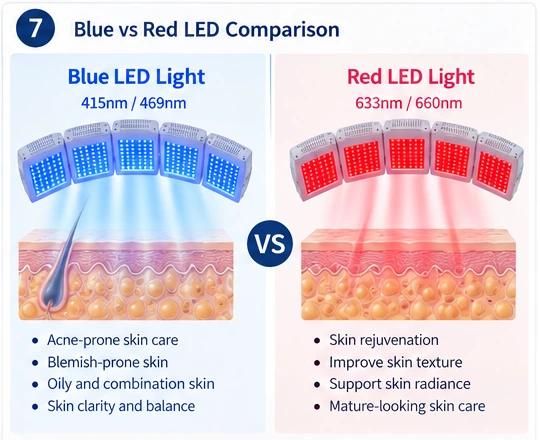
Blue LED Light vs Red LED Light
Blue and red LED light should not be treated as interchangeable technologies.
| Blue LED Light | Red LED Light | |
|---|---|---|
| Typical wavelength examples | 415nm / 469nm | 633nm / 660nm |
| Main aesthetic positioning | Acne-prone, oily, blemish-prone skin | Skin rejuvenation and conditioning |
| Skin-care focus | Clarity & balance | Texture & radiance |
| Common combination role | Acne-prone skin programs | Rejuvenation / recovery-oriented skin conditioning |
| Visible color | Blue | Red |
Blue LED light is generally more associated with blemish-prone and acne-prone skin programs, while red LED light is more commonly positioned for skin rejuvenation, texture and radiance.
This is why the two wavelengths can complement each other in professional multi-wavelength LED systems.
Why Combine Blue and Red LED Light?
Blue and red LED wavelengths are one of the most established multi-color combinations in professional LED skin care.
The logic is straightforward:
Blue LED
→ Acne-prone / blemish-prone skin focus
Red LED
→ Skin conditioning / rejuvenation focus
Combining them allows a clinic to build a more comprehensive program for clients who are concerned not only with visible blemishes but also with overall skin appearance.
Clinical studies have also evaluated combinations such as approximately 415nm blue + 633nm red light for mild-to-moderate acne-related applications. However, these clinical protocols should not be directly copied to another device without considering its actual optical output.
Learn More About Red + Blue LED Light Therapy for Acne-Prone Skin →
Blue LED Light for Oily Skin
Oily skin is a common concern in professional facial treatments and often occurs together with:
- blemish-prone skin
- combination skin
- congested-looking skin
- uneven skin clarity
Blue LED light can be incorporated into professional skin-balancing programs designed for these clients.
However, oil production is influenced by many physiological and environmental factors.
For this reason, the safest professional wording is:
Blue LED therapy can be used as part of a professional aesthetic program for oily and blemish-prone skin.
Does 469nm Blue Light Penetrate Differently from 415nm?
As wavelength increases within the visible spectrum, the way light is absorbed and scattered in tissue also changes.
In general, longer visible wavelengths tend to experience somewhat less scattering than shorter wavelengths, but actual tissue interaction depends on multiple optical properties.
Therefore, 469nm should not simply be described as:
“a deeper version of 415nm”
because wavelength-specific biological effects depend not only on penetration but also on which chromophores absorb the light.
For professional aesthetic equipment, the more useful distinction is:
415nm → stronger acne-related research relevance
469nm → broader longer-blue aesthetic skin-care option
This distinction makes it easier for clinics and distributors to understand why a multi-wavelength LED system may offer different blue-light configurations.
What Determines the Performance of a Professional Blue LED System?
Wavelength Accuracy
Professional equipment should clearly identify whether the system uses:
415nm
420nm
450nm
469nm
or another blue wavelength.
Simply stating “Blue Light” is not enough for professional equipment evaluation.
Irradiance
Irradiance indicates how much optical power reaches a given treatment area, typically expressed in:
mW/cm²
Energy Density
Energy density represents the total delivered optical energy and is commonly expressed in:
J/cm²
LED Distribution
A high LED count does not automatically mean better treatment performance.
Uniform facial illumination is also important.
Treatment Distance
Distance between the treatment panel and skin influences actual delivered irradiance.
Treatment Area
Professional equipment should provide sufficient coverage for efficient full-face treatment.
Treatment Protocol
Wavelength, irradiance and treatment time should be designed as one system.
Published protocols from another manufacturer's device should not automatically be copied.
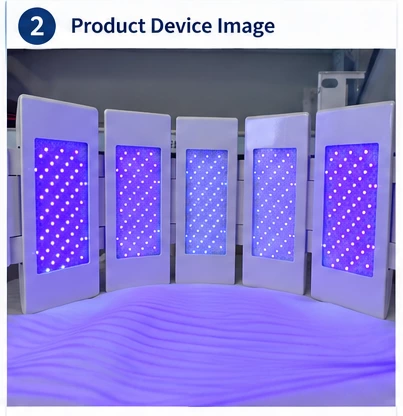
Professional Blue LED Therapy Systems from Omni Laser
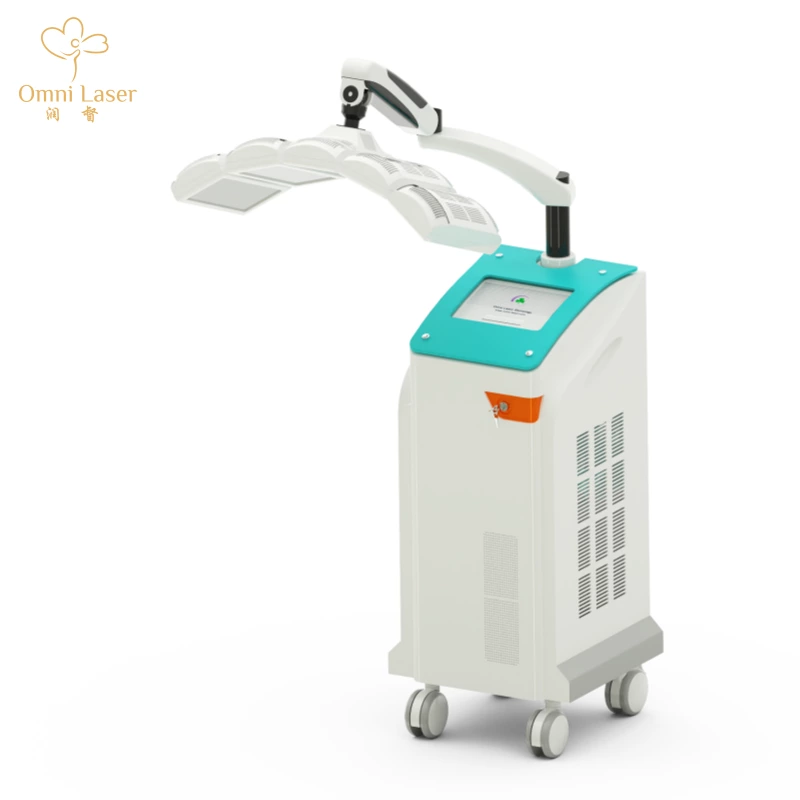
Omni Laser develops professional multi-wavelength LED phototherapy systems for:
- aesthetic clinics
- professional skin-care centers
- medical-aesthetic practices
- distributors
- OEM/ODM beauty equipment brands
Depending on the system configuration, Omni Laser LED platforms can incorporate wavelengths including:
Red Light
Blue Light
Yellow Light
Green Light
Near-Infrared Light
Blue-light configurations can be designed according to professional aesthetic applications, including wavelengths such as 415nm and 469nm, depending on the product platform and intended program.
For professional buyers, wavelength selection should be evaluated together with:
irradiance
LED quantity
optical uniformity
treatment area
treatment distance
software protocols
device stability
rather than judging the equipment by wavelength alone.
Frequently Asked Questions
What is blue LED light therapy used for?
In professional aesthetic skin care, blue LED light is commonly used in programs for acne-prone, oily and blemish-prone skin and to support clearer-looking skin.
What blue wavelength is commonly used for acne-prone skin?
Published acne-related blue-light research frequently uses wavelengths around 405–420nm, particularly approximately 415nm.
What is 469nm blue LED light used for?
469nm is a longer visible blue wavelength that can be incorporated into professional aesthetic programs for oily, blemish-prone or combination skin and broader blue-light skin conditioning.
Direct acne-specific clinical evidence for 469nm is currently less established than for wavelengths around 415nm.
Is 415nm better than 469nm?
Not necessarily.
415nm currently has stronger published evidence specifically related to acne-prone skin, while 469nm can serve a broader professional blue-light skin-care role.
The performance of an LED system also depends on output, dose, treatment distance and protocol.
Can 469nm be used for acne-prone skin?
It can be included in professional programs for acne-prone or blemish-prone skin, but the website should not imply that 469nm has exactly the same evidence base or biological action as 415nm.
Is blue LED light suitable for oily skin?
Blue LED light can be incorporated into professional aesthetic programs for oily and combination skin, particularly when oiliness occurs together with blemish-prone or congested-looking skin.
What is the difference between blue and red LED light?
Blue LED light is generally associated with acne-prone, oily and blemish-prone skin programs, while red LED light is more commonly used for skin rejuvenation, texture and radiance.
Can blue and red LED light be used together?
Yes. Blue and red LED light are frequently combined in professional multi-wavelength LED programs to address blemish-prone skin together with overall skin conditioning.
Professional LED Solutions for Acne-Prone and Oily Skin
Blue LED light has become an important component of modern professional aesthetic skin care.
However, not every blue wavelength should be treated as identical.
Shorter wavelengths around 415nm have the strongest established role in acne-related blue-light research, while longer wavelengths such as 469nm can expand the range of professional blue-light aesthetic skin-care programs.
For clinics and distributors, selecting a professional LED system should therefore involve more than simply choosing “Blue Light.”
Wavelength, irradiance, energy density, LED distribution, treatment area and treatment protocol should be evaluated together.